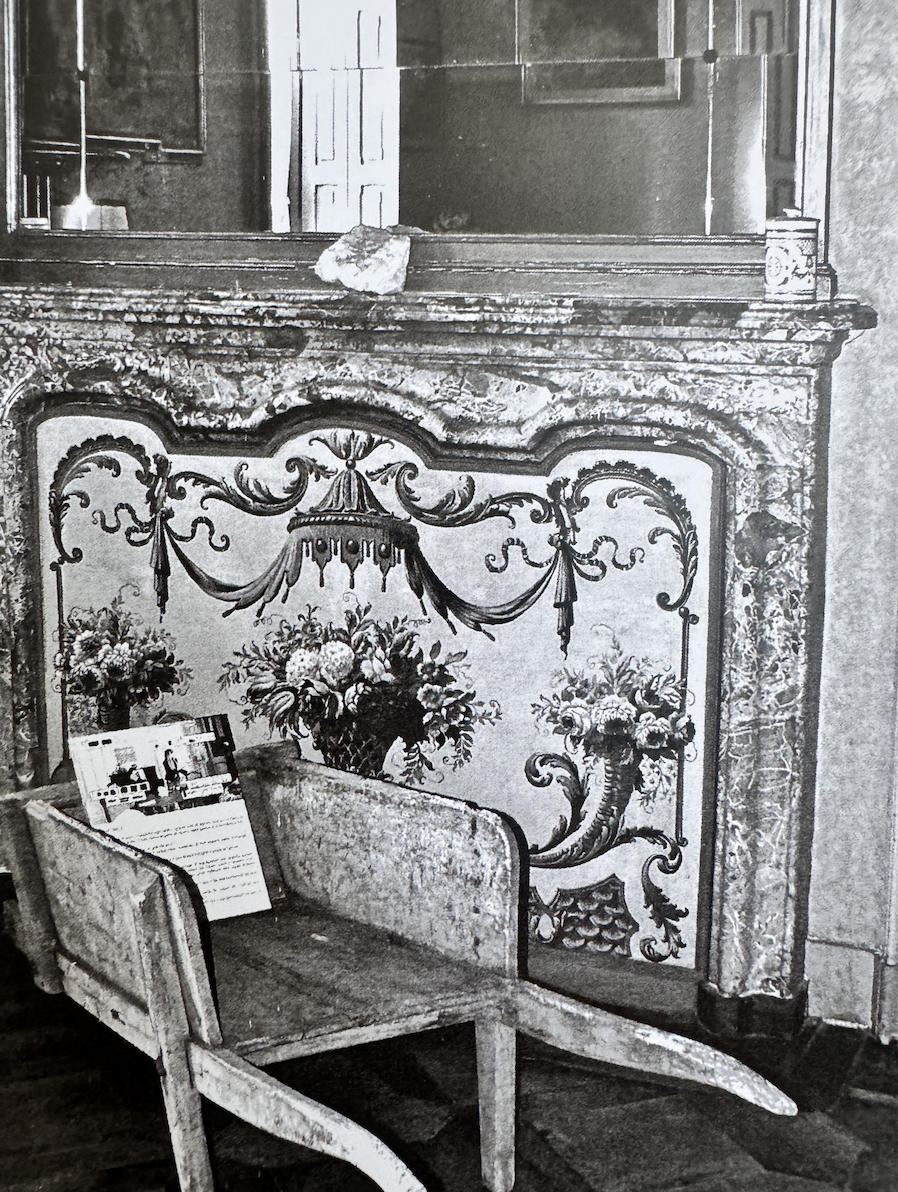
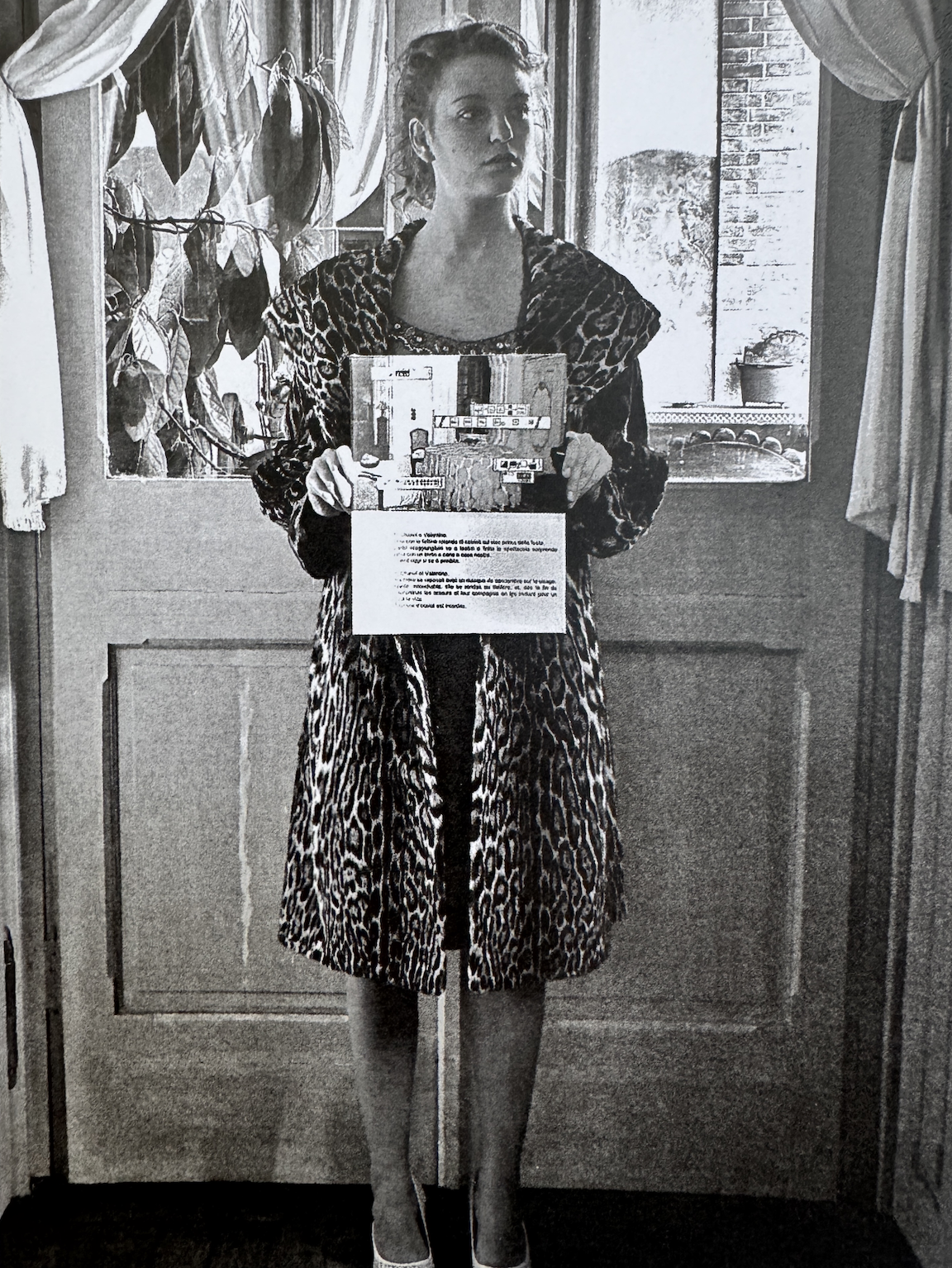
ANNE-CATHERINE CARON AND ROLAND SABATIER INSTALLATION AT VILLA CERNIGLIARO, ROMAN DE LA VILLA CERNIGLIARO, CHAPTERS
ANNE-CATHERINE CARON
ARTIST QUESTION AND ANSWERS WITH VICTORIA CHAPMAN
Out of respect for the artist's voice and original expression, her responses are presented first in French, followed by an English translation.
Q-1. On discovering Lettrism
What first drew you to Lettrism, and how did it change your understanding of what language, letters, and visual art could become? Do you see Lettrism primarily as an artistic movement, a philosophy, or an ongoing experiment?
ANNE-CATHERINE CARON:
À la découverte du Lettrisme
Qu'est-ce qui t’as d'abord attiré vers le Lettrisme, et comment cela a-t-il changé ta compréhension de ce que pouvait devenir le langage, les lettres et l'art visuel ? Considères-tu le Lettrisme principalement comme un mouvement artistique, une philosophie ou une expérience en cours ?
C’est mon désir d’écrire lors de mon adolescence qui exerça une attraction qui prit la forme d’une révélation.
Après mes principales lectures qui englobaient James Joyce, Virginia Woolf ou des écrivains comme Dos Passos, un vague sentiment du déjà vu possible, après la brisure des avant-gardes, coïncida avec ce que véhiculait le Lettrisme par l’épuisement de la prose narrative traditionnelle.
Rendre présent ce qui est absent est une définition possible de l’écriture et de nombreuses notations à dominante utilitaire. C’est un but ardu.
J’ai choisi la super-écriture qui, elle, est de nature esthétique et dans sa phase en partie déchiffrable pour Roman Lettriste, avec les photos des objets et les textes narratifs de Carlotta.
Je dois dire que j’aimais beaucoup les divers systèmes typographiques : égyptiens grecs ou mayas, l’imprimerie ou toutes les écritures historiques logographiques et cunéiformes, toutes proportions gardées, comme Rimbaud admirait les enluminures dans Une Saison en enfer:
« J'aimais les peintures idiotes, dessus de portes, décors, toiles de saltimbanques, enseignes, enluminures populaires... »
J’ai découvert Les Journaux des Dieux d’Isidore Isou, (1950, aux éditions Aux escaliers de Lausanne) une œuvre de « super-écriture », intégrant peu à peu des rébus, des images, des signes et des alphabets existants qui, par la suite, deviendront inventés. Une forme esthétique gratuite qui s’émancipera bientôt d’une sémantique précise (Essai sur la définition, l’évolution et le bouleversement total de la prose et du roman, publié conjointement aux Escaliers de Lausanne) dépassant les narrations qui pouvaient se multiplier à l’infini.
J’ai alors pensé qu’iil était possible d’aller au-delà de l’écriture romanesque traditionnelle pour embrasser, potentiellement, l’ensemble ou bien une partie de l’univers des signes de la communication visuelle.
C’est ainsi que j’ai conçu Roman à Équarrir, en 1976/1977, mais publié en janvier 1978 aux Editions Anakota, des neveux lettrés du Prince Sihanouk du Cambodge, réfugiés à Paris.
J’avais 23 ans et rencontré le mouvement Lettriste en 1972.
(Couverture de Roman à Équarrir).
Xxx
Cette école, fondée par Isidore Isou en 1945, un jeune Roumain brillant venant conquérir Paris avec sa nouvelle Avant-Garde (Introduction à une nouvelle poésie et à une nouvelle musique, Éditions Gallimard, 1947) est à la fois un courant artistique et une forme de pensée centrée sur la notion de création dans les principaux domaines du Savoir et de la Vie selon son créateur. De plus, Le Soulèvement de la Jeunesseconstitue la contribution du fondateur du Lettrisme à ce qu’il dénomme l’Economie Nucléaire.dont le tome 1 de son Traité fut publié en 1949 aux Escaliers de Lausanne. Elle expose que les « externes ». comprenant tous les exclus du système, notamment les minorités, les jeunes - actuellement touchés au niveau européen par un vent de contestation -, les femmes et les créateurs, représentent la catégorie réellement motrice d’une société plus éclairée.
C’est également, à mon sens, une expérience en cours pour les œuvres encore à accomplir, - l’idée d’une avant-garde qui serait toujours à l’avant-garde de l’avant-garde - comme dans l’hypergraphie (super-écriture, 1950), l’Art infinitésimal (imaginaire, 1956) ou l’Art des coordinations entre le plus minuscule et l’immensité (Excoordisme, défriché par Isou en 1992).
( mettre un extrait de Corrélation avec l’Eternité ).
ENGLISH TRANSLATIOn: Q-1
ANNE-CATHERINE CARON: Discovering Lettrism
It was my desire to write during adolescence that exerted a powerful attraction on me, taking the form of a revelation.
After my principal readings, which included James Joyce, Virginia Woolf, and writers such as Dos Passos, a vague sense that everything might already have been seen or done, following the rupture brought about by the avant-gardes, coincided with what Lettrism conveyed through the exhaustion of traditional narrative prose.
To make present what is absent is one possible definition of writing, as well as of many forms of notation that are predominantly utilitarian in nature. It is an arduous goal.
I chose super-writing, which is aesthetic in nature and, in its partially decipherable phase, suited to Roman Lettriste, with photographs of objects and narrative texts by Carlotta.
I must say that I was very fond of the various typographic systems—Egyptian, Greek, or Mayan—as well as printing and all historical logographic and cuneiform writing systems. In a somewhat comparable way, Rimbaud admired illuminated illustrations in A Season in Hell:
“I loved idiotic paintings, door panels, stage sets, backdrops for acrobats, signs, popular illuminations…”
I discovered Les Journaux des Dieux (The Journals of the Gods) by Isidore Isou (1950, published by Aux Escaliers de Lausanne), a work of “super-writing” that gradually incorporated rebuses, images, signs, and existing alphabets, which would subsequently give way to invented ones.
It was a purely aesthetic form, soon emancipating itself from precise semantic meaning (Essay on the Definition, Evolution, and Total Upheaval of Prose and the Novel, published simultaneously by Aux Escaliers de Lausanne), moving beyond narratives that could multiply infinitely.
I then thought it might be possible to go beyond traditional novelistic writing and potentially embrace the entirety, or at least part, of the universe of signs belonging to visual communication.
It was in this spirit that I conceived Roman à Équarrir in 1976–1977, although it was not published until January 1978 by Éditions Anakota, run by the educated nephews of Prince Sihanouk of Cambodia, who had taken refuge in Paris.
I was 23 years old and had encountered the Lettrist movement in 1972.
(Cover of Roman à Équarrir)
Xxx
This school, founded by Isidore Isou in 1945—a brilliant young Romanian who came to conquer Paris with his new avant-garde (Introduction to a New Poetry and a New Music, Éditions Gallimard, 1947)—is both an artistic movement and a form of thought centered on the concept of creation in the principal domains of Knowledge and Life, according to its founder.
Furthermore, The Uprising of Youth represents the Lettrist founder’s contribution to what he called Nuclear Economics, the first volume of his treatise having been published in 1949 by Aux Escaliers de Lausanne.
This theory proposes that the “externals”—encompassing all those excluded from the system, particularly minorities, young people (currently affected across Europe by a wave of protest), women, and creators—constitute the true driving force of a more enlightened society.
In my view, Lettrism is also an ongoing experiment, in terms of the works that have yet to be realized—an idea of an avant-garde that would always remain ahead of the avant-garde itself.
This can be seen in hypergraphy (super-writing, 1950), Infinitesimal Art (imaginary art, 1956), and the Art of Coordinations Between the Infinitesimal and Immensity (Excoordism, first explored by Isou in 1992).
(Insert an excerpt from Corrélation avec l’Éternité — Correlation with Eternity.)
Q-2: On the 14 Chapters of Villa Cernigliaro
Your Roman de la Villa Cernigliaro brings together visual language, personal history, and the architecture of the villa. How did you approach transforming Carlotta Cernigliaro's memories and the villa's history into fourteen chapters? What happens to a story when it is no longer dependent on conventional language?
ANNE-CATHERINE CARON:
2. Sur les 14 chapitres de la Villa Cernigliaro
Ton Roman de la Villa Cernigliaro réunit le langage visuel, l'histoire personnelle et l'architecture de la villa. Comment as-tu abordé la transformation des souvenirs de Carlotta Cernigliaro et de l'histoire de la villa en quatorze chapitres ? Qu'arrive-t-il à une histoire lorsqu'elle ne dépend plus du langage conventionnel ?
C’est précisément depuis l’œuvre que tu exposes, Roman Lettriste de la Villa Cernigliaro et grâce à ce roman, dont le personnage principal est la Villa de Carlotta, indissociable de sa propriétaire, que j’ai initié ce qu’il convenu d’appeler un chemin de mémoire en ce qui concerne les thématiques.
J’ai toujours été nostalgique, - ce qui constituait la matière que je voulais utiliser pour raconter - mais j’étais extrêmement prise par la vie comme dans un tourbillon avec le Lettrisme et l’existence elle-même qui, pour une part importante, se mélangeait intrinsèquement.
Les demeures comme celle de la Villa, m’intriguent au plus haut point. Il existe naturellement un phénomène d’identification entre la narratrice et la détentrice de ce lieu magique, cette Villa, si majestueuse, la sienne, au passé historique familial et artistique si riche qui vaut pour toutes celles dont j’ai rêvé ou bien auxquelles je rêvais depuis si longtemps sans même le savoir. Ceci est une matière et un ressort éminemment romanesque.
Ce travail est une entreprise visuelle, parce que sur la base des objets choisis par Carlotta, nous avons procédé à leur mise en scène - installation : elle constitue l’une des strates de mon travail et de ses représentations, reproductibles à travers la photographie qui narre et témoigne à travers les 14 chapitres. (Leur nombre est arbitraire, il aurait été possible qu’il y en ait davantage, cela a été le fruit de la sélection de Carlotta qui ne pouvait pas être exhaustive, de même que pour les espaces de la Villa qui a également intégré la terrasse). Ces éléments visuels ont pour moi la valeur de notations de ma narration.
Sur les photos marouflées - ces clichés relatant eux aussi une histoire autonome en référence aux expositions ayant eu lieu chez Carlotta - sur les toiles, l’on voit, en réalité, des agencements de signes purs… la super écriture et quelques-uns de mes signes qui viennent se superposer comme un nouveau récit.
À cet égard, on peut en outre se référer au texte, Signes ou Supports (& en même temps les deux) dans la prose; car son auteur Roland Sabatier m’a suivie dans mon élaboration et défini les principales et différentes structures de l’œuvre en préfaçant le livre-catalogue publié par Carlotta en 2011.
Comme un roman peut avoir pour ambition de représenter la vie, (sous forme visuelle et sonore comme la prose romanesque l’était aussi), il est multiple, foisonnant et embrasse des secteurs qui se plient à la nouvelles prose (ou anciennes renouvelées) et à d’anciennes narrations qui voudraient en questionner d’inédites. Pour les super-écritures, Il peut également comporter des formules ésotériques: des associations libres de mes notations pour désigner et signifier des simulacres des phrases de la prose alphabétique devenue désuète et caduque, tombée en désuétude.
(reprendre la couverture de l’anti-cinéma et mes planches de Attaché/Détaché sur Seine)
J’aime beaucoup l’originalité de ta question : Qu'arrive-t-il à une histoire lorsqu'elle ne dépend plus du langage conventionnel?
C’est le pendant que se pose Leonora Carrington, que j’admire pour la nature de son esprit, sur les objets lorsque des humains disparaissent. Elle pense que ces effets vivent des prolongements spirituels mais aussi concrets… dans une sorte d’autonomie…qui leur est propres.
Il me semble qu’une histoire essentiellement hypergraphique laisse une part plus importante encore à l’interprétation du lecteur que la prose habituelle et laisse les fantasmagories émerger. La super-écriture romanesque, telle que je la conçois dans ce roman, appartient au domaine de l’imaginaire. Ceci reste pour ceux qui souhaitent s’y pencher.
L’aspect iconique permet de figurer le jeu et le dialogue entre la détentrice et sa demeure prestigieuse ainsi que l’auteure - narratrice que, modestement, je représente.
Tout travail artistique ambitionne de conserver la mémoire d’une thématique, d’un sujet, dès lors qu’il est adopté.
ENGLISH TRANSLATION: q-2
anne-catherine caron:
q-2: on the 14 chapters of villa cernigliaro
It was precisely through the work you are exhibiting, Roman Lettriste de la Villa Cernigliaro, and thanks to this novel, whose principal character is Carlotta's villa, inseparable from its owner, that I began what might be called a journey through memory in relation to its themes.
I have always been nostalgic, and nostalgia was the material I wanted to use to tell a story. Yet I was also completely caught up in life, as though in a whirlwind, with Lettrism and existence itself becoming, to a considerable extent, intrinsically intertwined.
Residences such as the Villa intrigue me enormously. There is naturally a phenomenon of identification between the narrator and the owner of this magical place: the Villa, so majestic, belonging to her, with its extraordinarily rich family and artistic history. It stands for all those houses I had dreamed of, or had long been dreaming of without even knowing it. This is material of an eminently novelistic nature, and a powerful narrative impetus.
This work is a visual undertaking because, using the objects selected by Carlotta, we proceeded to stage and install them. This staging constitutes one of the layers of my work and its representations, which can be reproduced through photography, narrating and bearing witness across the fourteen chapters.
(The number of chapters is arbitrary; there could have been more. It resulted from Carlotta's selection, which could not be exhaustive. The same applies to the spaces of the Villa, which also included the terrace.)
For me, these visual elements have the value of notations within my narrative.
In the photographs mounted onto canvas—images that themselves recount an autonomous history in reference to exhibitions held at Carlotta's Villa—we see, in reality, arrangements of pure signs: super-writing, along with some of my own signs, superimposed upon them like a new narrative.
In this regard, one may also refer to the text Signs or Supports (& Both at the Same Time) in Prose, whose author, Roland Sabatier, accompanied me throughout the development of the work and defined its principal and various structures in his preface to the book-catalogue published by Carlotta in 2011.
Just as a novel may aspire to represent life—in visual and auditory form, as novelistic prose once did as well—it is multiple, abundant, and encompasses different realms that lend themselves to new forms of prose (or older forms renewed), as well as earlier narratives seeking to question and give rise to unprecedented ones.
Super-writing may also contain esoteric formulas: free associations of my notations intended to designate and signify simulations of sentences from alphabetical prose, which has become outdated, obsolete, and fallen into disuse.
(Note: Revisit the cover of the anti-cinema work and my plates from Attaché/Détaché sur Seine.)
I very much appreciate the originality of your question:
What happens to a story when it is no longer dependent on conventional language?
It has a parallel in a question posed by Leonora Carrington, whom I admire for the nature of her mind, concerning what happens to objects when human beings disappear.
She believed that these objects continue to exist through spiritual, but also tangible, extensions—in a kind of autonomy that belongs to them alone.
It seems to me that an essentially hypergraphic story leaves even greater room for the reader's interpretation than conventional prose, allowing phantasmagorias to emerge.
Novelistic super-writing, as I conceive it in this novel, belongs to the realm of the imagination. It remains there for those who wish to explore it.
The iconic dimension makes it possible to represent the interplay and dialogue between the owner and her prestigious residence, as well as the author-narrator, whom I modestly represent.
Every artistic undertaking aspires to preserve the memory of a theme or subject once it has been embraced.
Q-3. On reading and looking
When encountering a Lettrist work, should we attempt to decipher its meaning, or is the experience of looking, listening, and responding more important? How much freedom do you wish to give the viewer in creating their own interpretation?
anne-catherine caron:
q-3. Sur la lecture et la recherche
Lorsque nous sommes face à une hypergraphie, un travail sur la super-écriture, devrions-nous essayer de déchiffrer sa signification, ou bien l'expérience de la recherche, de l'écoute et de la réponse est-elle plus importante ?
Quelle marge de liberté est-il laissé au spectateur pour qu’il se forge sa propre interprétation ?
C’est une question importante qui complète ce que je dis ci-dessus et cela concerne à mon avis toutes les réalisations de cette tendance.
Dans ses théories, Isou distingue dans les arts, ce qu’il appelle l’amplique, (phase de construction), c’est-à-dire lorsque que ceux-ci se développent pour se perfectionner, comme par exemple, en peinture, le chemin parcouru depuis les Primitifs, Giotto, la Renaissance, jusqu’à la perfection accomplie par un Eugène Delacroix ou un Courbet au niveau de la représentation de l’objet, puis une phase de morcellement, le ciselant, ( phase de destruction) qui attaque le sujet, essentiellement à partir des Impressionnistes. Le thème qui s’étalait allègrement dans la phase de construction pleine se voit, peu à peu et sous différentes formes, nié.
Dans le Lettrisme, nous trouvons également les deux phases. Dans ce que je propose ici, je me situe, en partie, dans le ciselant pour la prose hypergraphique avec mon système de signes basé sur le carré et un certain nombre de signes de ponctuation ou assimilés. Il y a peu de véritables lettres dans ce travail sur les 14 chapitres et lorsqu’il y en a, elles symbolisent dans le cadre de ce roman, des résidus, des restes de la prose traditionnelle qui me poursuivent malgré moi.
La narration exécutée par Carlotta sur chaque objet peut se lire de manière autonome, toutefois pour moi, ce sont des « notations pures « qui se réfèrent à la phase lettriste, des signes, et non plus des significations.
« En fait je me situe, comme le dit Sabatier, entre, - avec toute la modestie qui s’impose - paradoxalement, Mallarmé et Isou, la fin de Mallarmé et sa disposition sur la page en quelque sorte, celle du Grand livre, le livre ouvert, le livre non terminé, celui du Hasard aussi, bien sûr…
Et puis la nouvelle écriture qui va au-delà des critères traditionnels, par une multiplicité de notations et de tous les signes de la communication visuelle (ou sonore) ou bien sa raréfaction systématique comme c’est le cas dans ce Roman, est le biais que j’ai choisi pour travailler.
english translatioN: Q-3
anne-catherine caron:
q-3: on reading and looking:
This is an important question that complements what I have said above, and in my opinion, it concerns all works produced within this artistic tendency.
In his theories, Isou distinguishes two phases in the arts. The first is what he calls the amplic (the constructive phase), during which the arts develop toward ever greater refinement and perfection. In painting, for example, this can be seen in the progression from the early masters, Giotto, and the Renaissance, through to the perfection achieved by artists such as Eugène Delacroix or Courbet in their representation of the object.
This is followed by a phase of fragmentation, the chiseling phase (ciselant, or destructive phase), which attacks the subject, beginning essentially with the Impressionists. The subject matter, which had flourished so freely during the fully developed constructive phase, is gradually negated in various ways.
Within Lettrism, we also find these two phases.
In what I am presenting here, I situate myself partly within the ciselant phase of hypergraphic prose, through my system of signs based on the square and a certain number of punctuation marks or related symbols.
There are very few actual letters in this work on the fourteen chapters, and when they do appear, they symbolize, within the context of this novel, residues or remnants of traditional prose that continue to pursue me despite myself.
The narrative created by Carlotta for each object can be read independently. However, for me, these are "pure notations"that refer to the Lettrist phase—signs rather than meanings.
In fact, as Sabatier has said, I situate myself—with all due modesty—paradoxically between Mallarmé and Isou.
At the end of Mallarmé's work, there is, in a sense, his arrangement of elements upon the page, that of the Great Book, the open book, the unfinished book, and, of course, the book of Chance.
And then there is the new writing, which moves beyond traditional criteria through a multiplicity of notations and all the signs of visual (or auditory) communication—or, conversely, through their systematic reduction, as is the case in this Roman.
This is the approach I have chosen for my work.
q-4: On memory, place, and the passage of time
Villa Cernigliaro carries generations of personal and cultural memory. How does a physical place influence the language of your work? Can Lettrism become a means of preserving memory while simultaneously allowing it to be transformed or reinvented?
anne-catherine caron:
q-4. Sur la mémoire, le lieu et le passage du temps
La Villa Cernigliaro porte des générations de mémoire personnelle et culturelle. Comment un lieu physique influence-t-il la langue de ton travail ? Le Lettrisme peut-il devenir un moyen de préserver la mémoire tout en lui permettant d'être transformé ou réinventé ?
Nous sommes les paysages, nous sommes les demeures que nous habitons car elles nous représentent sur Terre, comme mécanique, c’est-à-dire comme support matériel servant à la réalisation possible d’une œuvre : le concept de la méca-esthétique intégrale défendu par le mouvement lettriste.
Les demeures : les architectures, les Villas, les berceaux des origines, les histoires qui s’y trament sont éminemment romanesques. Et mon souci formel se situe dans la tentative du renouvellement de la prose au travers des instruments légués par l’école à laquelle j’appartiens.
Le Château de Nohant de l’écrivaine George Sand qui fut l’amante de Frédéric Chopin ou d’Alfred de Musset visité durant mon enfance, non loin de Châteauroux, ma ville natale, oû se trouvaient les Américains de la base de l’OTAN des années soixante, Sèvres et sa manufacture qui fabriquait le fameux bleu roi et où que j’ai habité dans la maison familiale avant de devoir l’abandonner pour des questions d’héritage sont tous des éléments qui se reflètent aussi pour moi dans la Villa Cernigliaro et racontent aussi les histoires, les joies et les tourments des filles du notaire venu de Sicile qui accueillit aussi la Résistance italienne et ce qui se fit du meilleur dans la culture italienne du XXe siècle avec, notamment, Benedetto Croce ou Cesare Pavese.
Ces grandes Villas italiennes, qu’elles soient palladiennes ou néoclassiques, sont le réceptacle d’un universalisme qui fait le bonheur de tous celles.ceux qui apprennent à les connaître.
Tout travail artistique ambitionne de conserver, comme je le dis plus, la mémoire d’une thématique, d’un sujet, dès lors qu’il est choisi, comme l’épopée de la Villa de Carlotta dans Roman Lettriste de la Villa Cernigliaro.
De plus, il existe dans mon travail et mon adhésion au Lettrisme, ce que je pourrais appeler un parti pris de « formalisme ». En ce sens, l’usage de l’hypergraphie sert pour dessiner le récit de la Villa comme je l’ai perçu personnellement et comme Carlotta me l’a transmis, de même que ses proches.
C’est aussi la mémoire de toutes les expositions et du travail éditorial accompli avec Carlotta et mon compagnon Roland Sabatier jusqu’en 2022, puis des hommages qui lui ont été rendus.
Préserver, transformer ou / et réinventer: ce sont là les finalités de l’écriture et donc de la super-écriture comme nous le disions plus haut. Conserver ce qui n’est plus ou ne le sera plus, c’est le sens de ma démarche, du point de vue thématique: tenter de recueillir, de saisir, de consigner des bouts/fragments de mémoire pour qu’elle reste un petit peu.
Au niveau formel, c’est naturellement une interprétation, la restitution de ce que j’ai saisi des objets et des symboles qu’ils véhiculent pour Carlotta d’après ma compréhension.
Et bien sûr, il y a les textes - témoignages rédigés par la directrice de la Villa et Centre d’art au sujet de chacun des objets sélectionnés.
Comme Sabatier l’explique, ils valent comme signes issus de l’alphabet latin jouant comme une signification qui se superposent aux photographies hypergraphiées et donc hypergraphiques des 14 chapitres.
C’est un petit Road Movie, genre que j’affectionne tout particulièrement, à travers le temps, les espaces, les paysages mentaux et les méandres de nos souvenirs collectifs qui se trouvent résumés entre les murs de la Villa et en ses espaces extérieurs si bien entretenus, mais laissés aussi à l’état de nature par Carlotta.
Il y a dans cette demeure une idée de maîtrise qui ne transparaît pas dès le premier abord. Il y a un ordre de la pensée rigoureuse qui n’impose rien, mais qui choisit ses formes esthétiques et, si je puis dire -, presque sa politique.
english translation:Q-4
anne-catherine caron:
q-4: On memory, place, and the passage of time
We are the landscapes; we are the houses we inhabit, for they represent us on Earth, functioning as a mechanism—that is, as a material support through which the realization of a work of art becomes possible. This is the concept of integral meca-aesthetics advocated by the Lettrist movement.
Houses, architecture, villas, the cradles of our origins, and the stories that unfold within them are inherently novelistic. My formal concern lies in the attempt to renew prose through the instruments bequeathed to us by the artistic school to which I belong.
The Château de Nohant, home of the writer George Sand, who was the lover of Frédéric Chopin and Alfred de Musset, which I visited during my childhood not far from Châteauroux, my birthplace, where Americans were stationed at the NATO base during the 1960s; Sèvres and its porcelain manufactory, which produced the famous royal blue, where I lived in the family home before having to relinquish it because of inheritance matters—all of these places and experiences are reflected for me in Villa Cernigliaro.
They also evoke the stories, joys, and torments of the daughters of the notary who came from Sicily, who welcomed the Italian Resistance as well as some of the finest figures of twentieth-century Italian culture, notably Benedetto Croce and Cesare Pavese.
These great Italian villas, whether Palladian or Neoclassical, are repositories of a universalism that brings joy to all those who come to know them.
Every artistic undertaking aspires to preserve, as I mentioned earlier, the memory of a theme or subject once it has been chosen, just as the epic history of Carlotta's Villa is preserved in Roman Lettriste de la Villa Cernigliaro.
Furthermore, within my work and my commitment to Lettrism, there exists what I might call a deliberate inclination toward formalism. In this sense, the use of hypergraphy serves to draw or trace the narrative of the Villa as I personally perceived it and as Carlotta, along with those close to her, conveyed it to me.
It is also the memory of all the exhibitions and editorial work undertaken with Carlotta and my companion, Roland Sabatier, until 2022, followed by the tributes paid to him.
To preserve, transform, and/or reinvent: these are the purposes of writing and, therefore, of super-writing, as we discussed earlier.
To preserve what no longer exists, or what one day will cease to exist, is the meaning of my approach from a thematic perspective: to attempt to gather, grasp, and record fragments of memory so that something of it may remain, if only a little.
On a formal level, it is naturally an interpretation, a reconstruction of what I have understood of the objects and the symbols they carry for Carlotta, according to my own perception.
And, of course, there are the written texts—the testimonies composed by the director of the Villa and Art Centre concerning each of the selected objects.
As Sabatier explains, these texts function as signs derived from the Latin alphabet, carrying meaning that is superimposed upon the hypergraphed, and therefore hypergraphic, photographs of the fourteen chapters.
It is a little road movie, a genre of which I am particularly fond, moving through time, spaces, mental landscapes, and the winding paths of our collective memories, all of which are condensed within the walls of the Villa and its exterior spaces, so carefully maintained by Carlotta while also being allowed to remain in their natural state.
There is, within this residence, an idea of mastery that is not immediately apparent.
There is an order of rigorous thought that imposes nothing, yet chooses its aesthetic forms and, if I may say so, almost its politics.
q-5: On the continuing relevance of Lettrism
In a world increasingly dominated by digital images, abbreviated language, and rapidly changing forms of communication, what possibilities does Lettrism offer contemporary artists? Do you believe its original radical intentions remain relevant today?
anne-catherine caron:
q-5. Sur la pertinence continue du Lettrisme
Dans un monde de plus en plus dominé par les images numériques, le langage abrégé et les formes de communication en évolution rapide, quelles possibilités le Lettrisme offre-t-il aux artistes contemporains ? Pensez-vous que ses intentions radicales initiales restent pertinentes aujourd'hui ?
Il convient d’ajouter qu’aujourd’hui le cœur de ma démarche consiste à m’inspirer du lieu. Je n’expose pas en soi, si je suis l’organisatrice, j’adopte le cadre dans lequel les œuvres sont montrées. Elles se fondent avec le lieu. J’essaie de faire en sorte qu’il existe une sorte de fusion pour aboutir, au fond, au Roman Lettriste de la Villa Cernigliaro.
Nous avons mis en place cela avec Sabatier qui en a eu l’idée pour Collection lettriste: intime et ultime qui était une exposition collective de 2007.
Dans cette optique, les œuvres s’intègrent au mobilier, au décor et, par conséquent, pour nous, à ce que nous comprenons de son esprit.
On les retrouve donc à l’occasion, sur une table, par terre, dans l’escalier monumental de la Villa ou sur le lit de l’une des magnifiques chambres de l’étage noble, avec les lithographies d’Isou, éditées par Francesco Conz que nous avions rencontré lors de la venue d’Isou que j’avais personnellement organisée à Milan, en 1985, pour un récital mémorable où le créateur du Lettrisme s’était déshabillé sur scène, comme en témoigne le film Jusqu’au bout dans le Lettrisme que tu présentes également.
C’est exactement ce que tu fais toi-même, Victoria, dans ton accrochage au Nido et c’est cela qui m’enchante. Un positionnement où la polarisation et la sacralisation sont l’objet d’un décalage. Les œuvres font partie de l’environnement, elles accompagnent comme des amies.
( il y a des collectionneurs qui dialoguent et tutoient leurs pièces, je trouve cela vraiment charmant! )
( reproductions Collection lettriste ).
Les formes numériques sont, à mon sens, comme une sorte de confirmation des théories d’Isou, notamment dans les arts plastiques, puisqu’elles intègrent la totalité des signes de la communication visuelle et sonore.
Les formes plus anciennes écrites sur des mécaniques traditionnelles, comme sur des supports numériques ne sont eux aussi que des instruments, ils restent des moyens de communiquer, ils ne sont pas la communication elle-même.
Cela dément la pensée dominante, la doxa qui aimait, il y a quelque temps, répéter la célèbre phrase de McLuhan : The medium is the message.
La polythanasie (art des multiples -destructions), l’art imaginaire, l’art supertemporel (la participation du public), toutes les formes de la super-écriture, l’anti-cinéma, la photographie ciselante (destructive), la méca-esthétique intégrale (la science des supports) sans tout citer, sont des concepts défendus par le mouvement lettriste, avec des manifestes et des textes nombreux, avant même les années 60.
C’est en grande partie aujourd’hui ce qui se fait dans ce que l’on appelle l’Art contemporain où une pluralité de pratiques peuvent être observées et incluent bien souvent des écoles s’inspirant de Dada, du Surréalisme par exemple.
Je pense qu’il y a beaucoup à explorer encore dans de multiples secteurs du Lettrisme comme l’architecture où les formes destructives théorisées par Isou et illustrées notamment par Sabatier (comme les « presque meubles), se voient confirmées par les constructions actuelles, si l’on pense aux tours bancales, tronquées ou presque invisibles des Émirats Arabes ou d’Amérique du Nord par exemple.
Sans être une militante étriquée, je pense que la méthode de création inventée et théorisée par Isidore Isou peut encore offrir des voies d’expression que nous avons encore du mal à imaginer. Il est opportun de s’y attacher en poursuivant notre travail de propagation comme nous le faisons grâce à la collaboration fructueuse et précieuse de Carlotta Cernigliaro et aussi des curatrices et curateurs curieuses.x et passionné.es par les arts à l’image de ton travail de recherche profond et attentif que tu me fais l’honneur de découvrir avec ta méthode, ce Nid des Alphabets et notations que je trouve si chaleureux.
Novembre 2026.
english translation:Q-5
anne-catherine caron:
q-5: On the Continuing Relevance of Lettrism
It should be added that today, the heart of my approach consists of drawing inspiration from the place itself. I do not simply exhibit works as such. If I am the organizer, I embrace the setting in which the works are presented. They merge with the place. I try to create a kind of fusion that ultimately leads, in essence, to the Roman Lettriste de la Villa Cernigliaro.
We developed this approach together with Sabatier, who conceived the idea for Collection lettriste: intime et ultime, a group exhibition held in 2007.
From this perspective, the works become integrated into the furniture, the décor, and consequently, into what we understand to be the spirit of the place.
Thus, we occasionally find them on a table, on the floor, along the Villa's monumental staircase, or upon the bed in one of the magnificent rooms on the piano nobile (noble floor), alongside lithographs by Isou published by Francesco Conz.
We had met Francesco Conz during Isou's visit to Milan in 1985, which I had personally organized for a memorable recital during which the founder of Lettrism undressed on stage, as documented in the film Jusqu'au bout dans le Lettrisme (To the Very End in Lettrism), which you are also presenting.
This is exactly what you yourself are doing, Victoria, in your installation at El Nido, and it is what delights me.
It is an approach in which the conventional positioning and sacralization of artworks are displaced. The works become part of their surroundings; they accompany us like friends.
(There are collectors who converse with their artworks and address them familiarly. I find that truly charming!)
(Reproductions from Collection lettriste.)
Digital forms are, in my view, a kind of confirmation of Isou's theories, particularly in the visual arts, since they incorporate the full range of signs used in visual and auditory communication.
Older forms of writing on traditional physical supports, just like those on digital platforms, are merely instruments. They remain means of communication; they are not communication itself.
This contradicts the prevailing orthodoxy, the doxa, which, some time ago, was fond of repeating McLuhan's famous phrase: "The medium is the message."
Polythanasia (the art of multiple destructions), imaginary art, supertemporal art (public participation), all forms of super-writing, anti-cinema, chiseling (destructive) photography, and integral meca-aesthetics (the science of supports)—to name only a few—are concepts championed by the Lettrist movement through numerous manifestos and theoretical writings, even before the 1960s.
To a large extent, these are the very practices we encounter today in what is called contemporary art, where a plurality of artistic approaches can be observed, often including movements inspired by Dada and Surrealism, for example.
I believe there is still much to explore across the many fields of Lettrism, including architecture, where the destructive forms theorized by Isou and illustrated in particular by Sabatier (such as his "almost furniture") seem to find confirmation in contemporary constructions.
One might think, for example, of the leaning, truncated, or nearly invisible towers found in the United Arab Emirates or North America.
Without being a narrow-minded militant, I believe that the method of creation invented and theorized by Isidore Isou can still offer avenues of expression that we can scarcely imagine today.
It is important to remain engaged with this work by continuing our efforts to disseminate it, as we are doing through the fruitful and invaluable collaboration of Carlotta Cernigliaro, as well as through the work of curious and passionate curators.
Your own deeply attentive and thoughtful research is an example of this. You have done me the honor of allowing me to discover your approach and your method, this Nest of Alphabets and Notations, which I find so warm and welcoming.
November 2026
A SPECIAL thank you TO anne-catherine caron
courtesy of carlotta cernigliaro, and ASSOCIAZIONE ZERO GRAVITÀ VILLA CERNIGLIARO PER ARTI E CULTURE, SORDEVOLO, ITALY
El nido by vc projects founded by victoria chapman, published on november 20, 2026, los angeles
14 CHAPITRES - ROMAN DE LA VILLA CERNIGLIARO
translated from french to english
CHAPITRE 1 PANEL
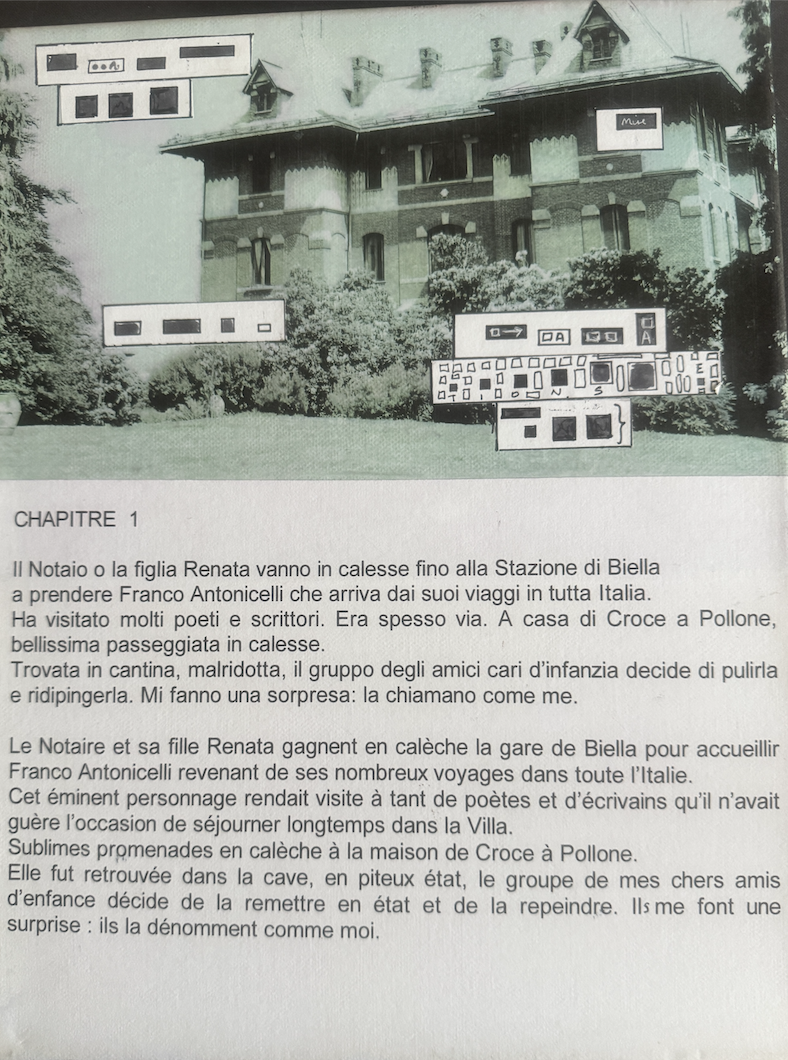
CHAPTER 1
The Notary and his daughter Renata would travel by horse-drawn carriage to the Biella railway station to welcome Franco Antonicelli upon his return from his many journeys throughout Italy.
This distinguished figure visited numerous poets and writers, and consequently had little opportunity to spend extended periods at the Villa.
There were magnificent carriage rides to the Croce family home in Pollone.
The carriage was later discovered in the cellar, in rather poor condition. A group of my dear childhood friends decided to restore and repaint it.
They surprised me by giving it my name.
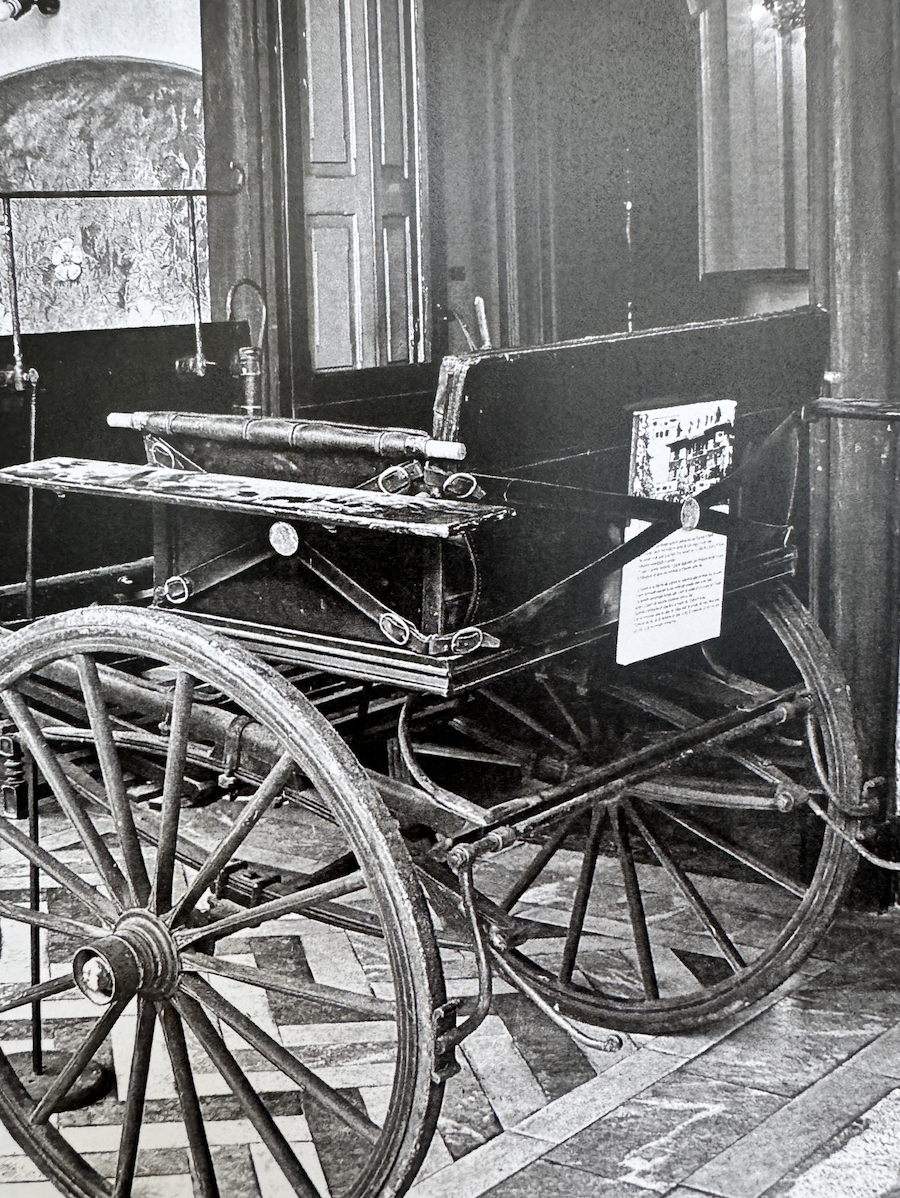
ANNE-CATHERINE CARON AND ROLAND SABATIER INSTALLATION AT VILLA CERNIGLIARO, ROMAN DE LA VILLA CERNIGLIARO, CHAPTERS
CHAPITRE 2 PANEL
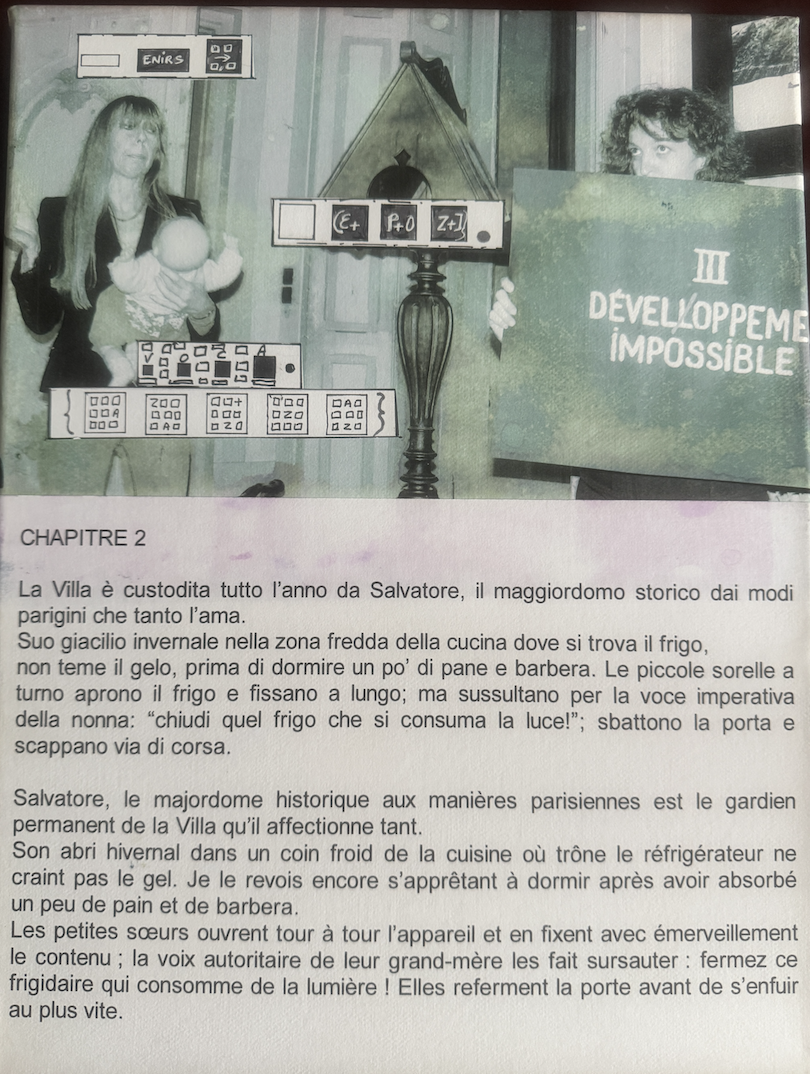
CHAPTER 2
Salvatore, the longtime butler with Parisian manners, is the year-round caretaker of the Villa, which he loves so dearly.
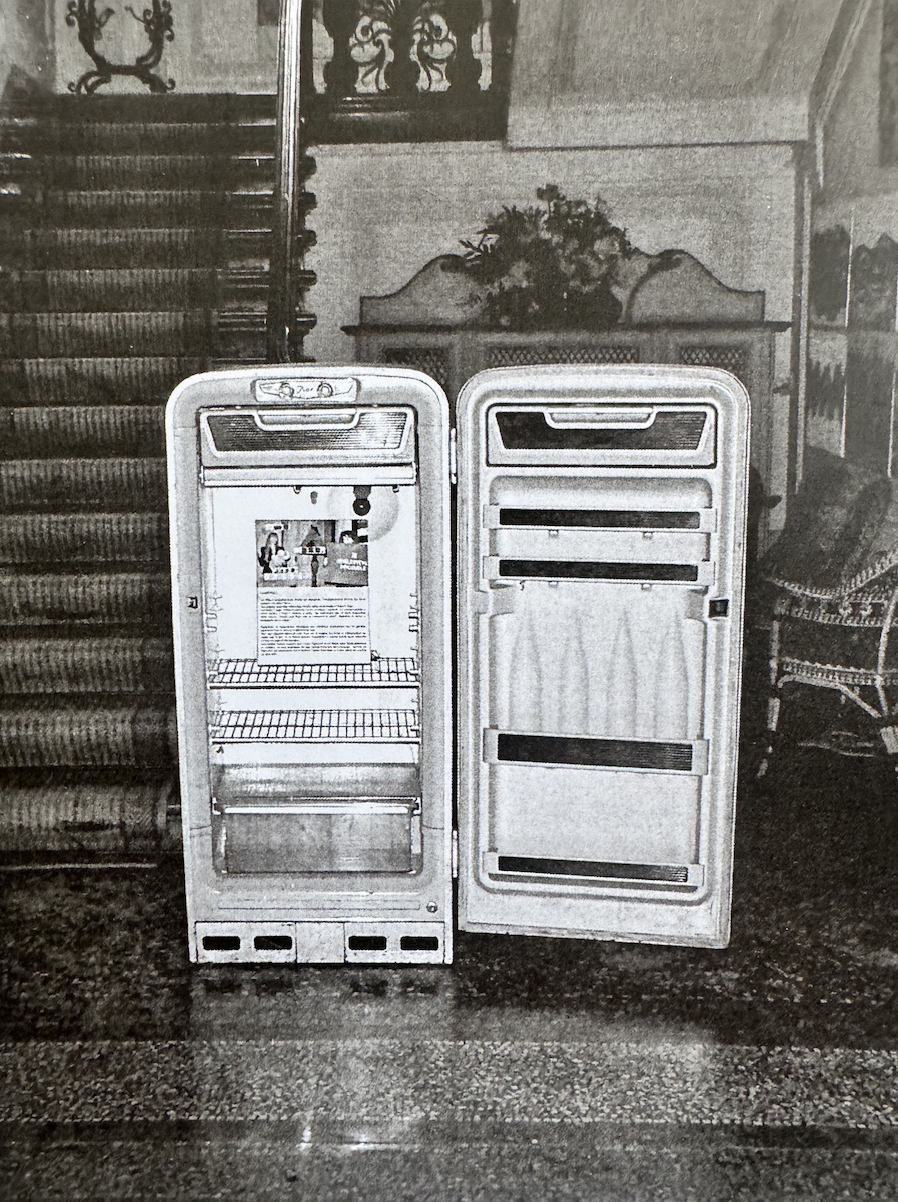
His winter refuge is in a cold corner of the kitchen, where the refrigerator stands. He is not afraid of the freezing temperatures. I can still picture him preparing for sleep after having a little bread and Barbera wine.
The younger sisters take turns opening the refrigerator and gazing in wonder at its contents. Their grandmother’s commanding voice startles them:
“Close that refrigerator! You’re using up all the light!”
They quickly shut the door and run away as fast as they can.
ANNE-CATHERINE CARON AND ROLAND SABATIER INSTALLATION AT VILLA CERNIGLIARO, ROMAN DE LA VILLA CERNIGLIARO, CHAPTERS