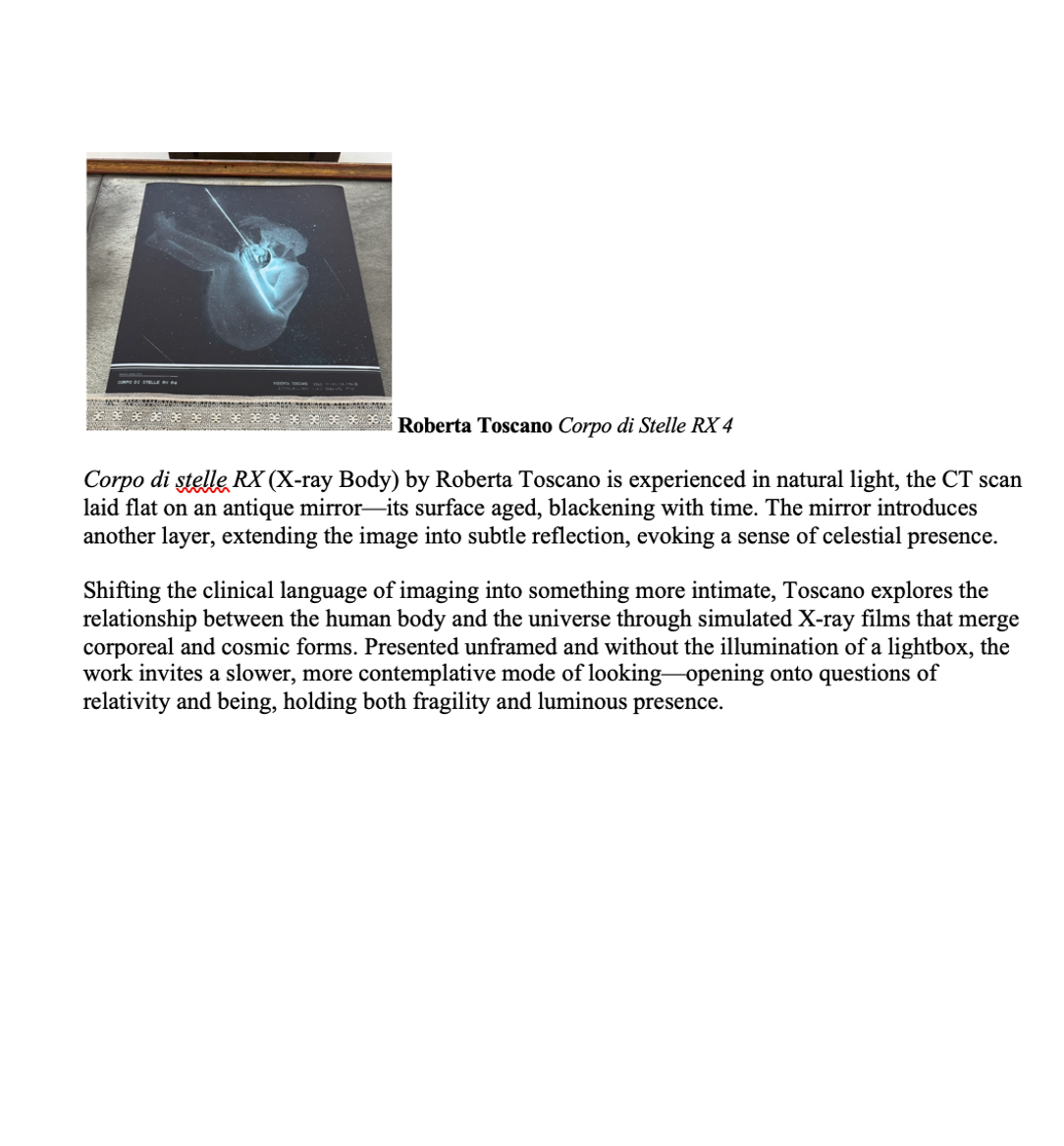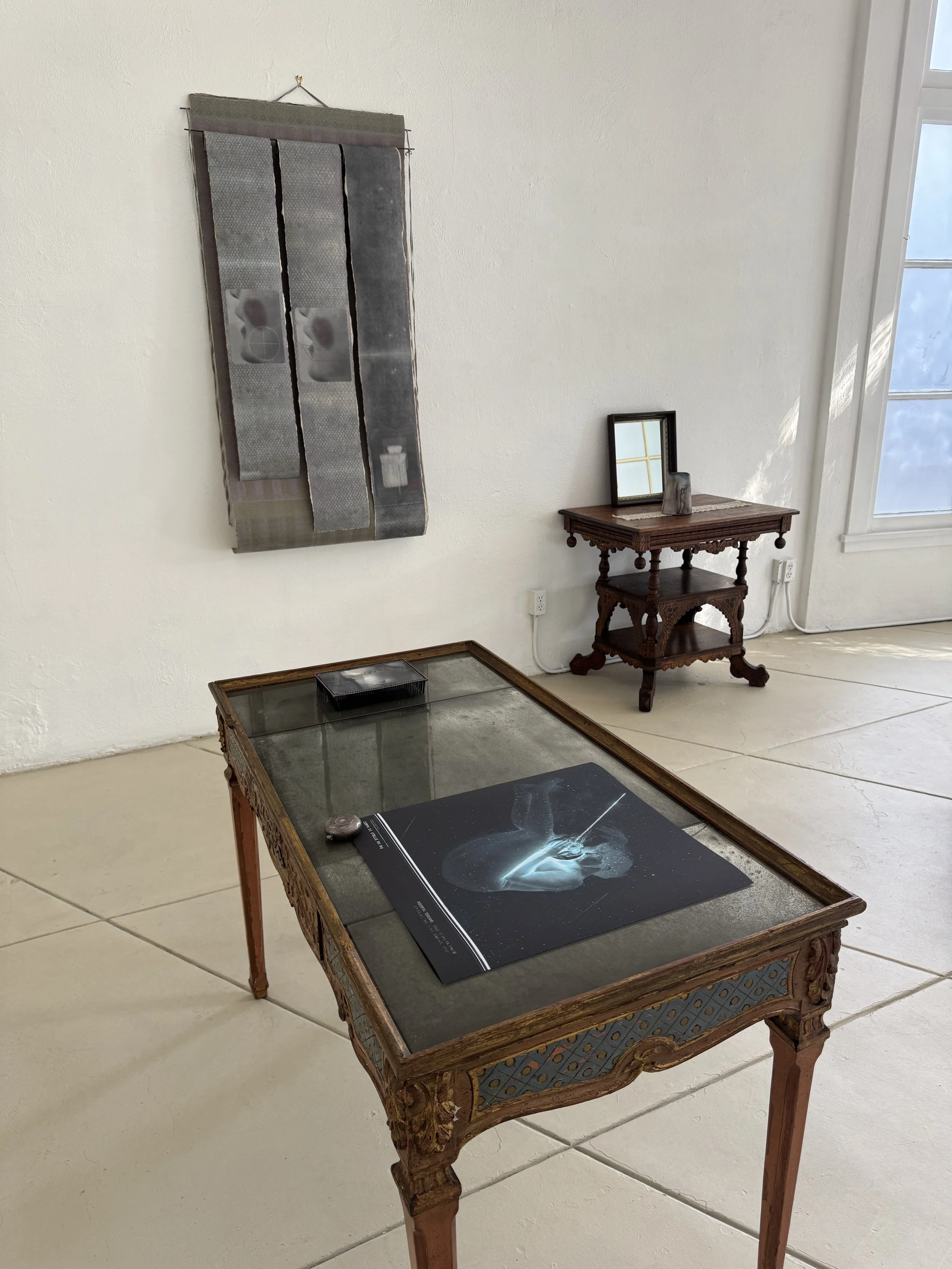
ROBERTA TOSCANO, 2025, CORPO DI STELLE RX 04 (ON MIRRORED DESK)
INTERVIEW WITH ROBERTA toscano- Corpo di stelle RX 04 -
certain scientific theories suggest that we come from space and that our bodies originate from stardust
Body and Cosmos
QUESTION 1 - In Corpo di stelle RX, the body and the cosmos seem to gently merge into one another. How did this relationship first begin to take shape in your mind?
ROBERTA: Corpo di stelle RX is the natural continuation of a journey that began in 2014 with my first project involving luminous suitcases. It brings together three pillars of my research: the use of recycled objects, photographic self-portraiture, and an environmental gaze. In these backlit photographs, my body becomes an icon, digitally modified and clothed in infinite starry skies. This enchanted fusion describes the essence of the human experience (and specifically that of the artist), who holds a privileged relationship with a dreamlike dimension, suspended in time. When looking up at the sky, I think about how we are children of the stars and how human beings were actually born from space; in this sense, it was meant as a way to offer hope.
QUESTION 2 - The work suggests a kind of quiet continuity between the human body and the universe. Is this something you feel intuitively, or something you arrived at through research and process?
ROBERTA: In my photographic practice, I have always essentially sought light. To restore its value as a source of wonder and hope within an artwork, I began building lightboxes. As for the cosmos, certain scientific theories suggest that we come from space and that our bodies originate from stardust. Perhaps this is why our genetic heritage still preserves, in its deepest recesses, the indelible memory of that ancient origin, something we perceive as a light in the darkness. With this series, I wanted to "raise my gaze toward the sky" to create more contemplative works, open to the pure joy of existence. Though I must admit, this is an unusual direction for me, as my pieces generally maintain a sharp, critical approach toward our daily reality, which can sometimes be unsettling and disquieting.
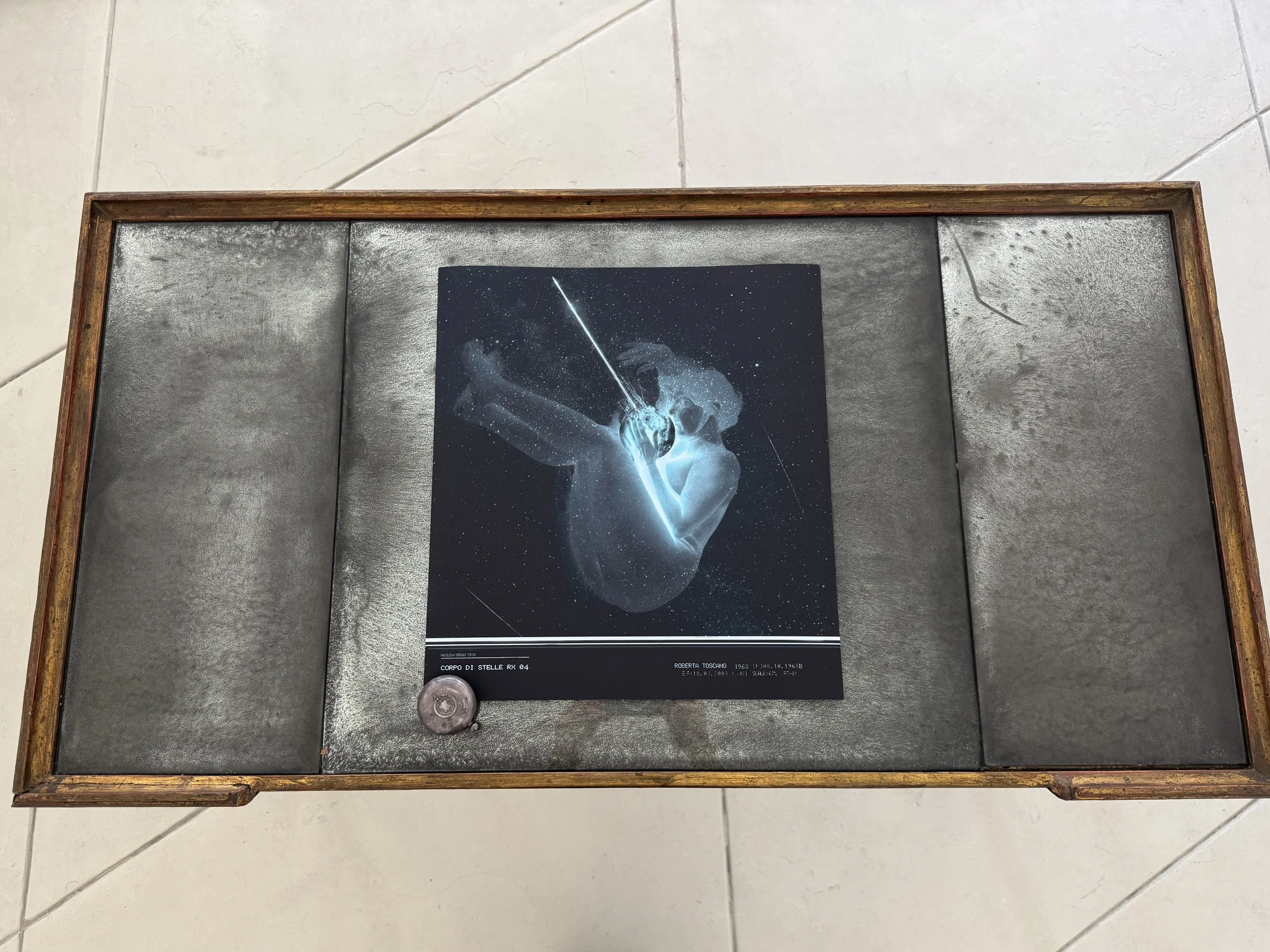
Roberta Toscano, 2025, Body of Stars RX 04 , Digital processing on blacklight film | size 16 x 14.5 inches, Edition 1/ 3
On Seeing Through and Beyond
QUESTION 3 - You work with former X-ray viewing tables—objects once used to look inside the body. What drew you to these materials, and what do they hold for you now?
ROBERTA: I spend a great deal of time wandering through flea markets and antique shops, and in one of them, I came across an old, discarded X-ray viewer. Since it is effectively a lightbox, it aligned perfectly with my artistic process. This object made me think about the possibility of entering the body itself, its mystery, its fragility, and its hidden potential, by means of a technological device. Later on, with the help of some doctor friends, I collected other obsolete illuminated medical supports and created new images of human and celestial "bodies" existing in dialogue or in an intrinsic state of union. These images simulate X-ray plates to intensify their evocative quality and evoke the past. There is also a powerful resonance with my personal memory: if ten years ago I had not encountered illness on my path, this conceptual and therapeutic process would have never begun. Fortunately, my health crisis is also a story of healing, long and difficult, but ultimately resolved. Every time a new day begins, I am still here. Infusing lived experience into medical science and technology transforms them into something deeply poetic and movingly human. After all, the concept of "care" is fundamentally an act of love for someone or something.
QUESTION 4 - There is a subtle shift in your work—from revealing what is hidden within the body, to revealing something more expansive. What does it mean, for you, to "see beyond"?
ROBERTA: Art is a privileged medium for analyzing reality. For me, it offered the opportunity to grasp the difference between merely living in reality and truly existing within the deep meaning of life. I have always possessed a strong drive toward life, yet I have a difficult and strained relationship with a world that I find unfair in many aspects. Being able to accept the material dimension, the hardships, and the tragedy of life—while knowing there is a plane where these objective realities can fade into the background—is what gives meaning to everything. I am not a religious person, but I believe in human existence as a spiritual value. Had I been a factory worker or a public servant, I wouldn't have been able to devise and apply this philosophy to my daily job, but as an artist, I can. I can bring this vision to light for others to see, moving past mere self-referentiality. Even though I always start from my own self-portrait, I consider my body detached from my strict identity: it becomes a collective, human body, anchored in a deeply feminine perspective.
On Image, Layering, and Transformation
QUESTION 5 - The images are composed through layering—body, moon, earth, stars. How do you approach this act of bringing different visual worlds together?
ROBERTA: I isolated fragments of my own body, or my figure as a whole, and placed this feminine form into a stellar environment, seeking the composition that was most aesthetically fulfilling to me. To do this, I used NASA imagery of the Milky Way and other celestial bodies. It is a union between the physical human body and cosmic entities, crafted to generate the greatest visual softness. You can find the sun, the moon, the Earth viewed from space, and shooting stars. The images are inverted to mimic X-ray plates as closely as possible, which adds another layer of fascination: the body is recognizable, yet it is transformed into a more alien, otherworldly image.
QUESTION 6 - Do you think of these images as constructed, discovered, or perhaps something in between?
ROBERTA: They are dynamic images; they could be thought of as a work still in progress. It is a dance, an encounter, like a single frame taken from a video. It conveys the fluid energy of a journey, which is further amplified by the soundtrack I chose for the installation a piece composed by my son.
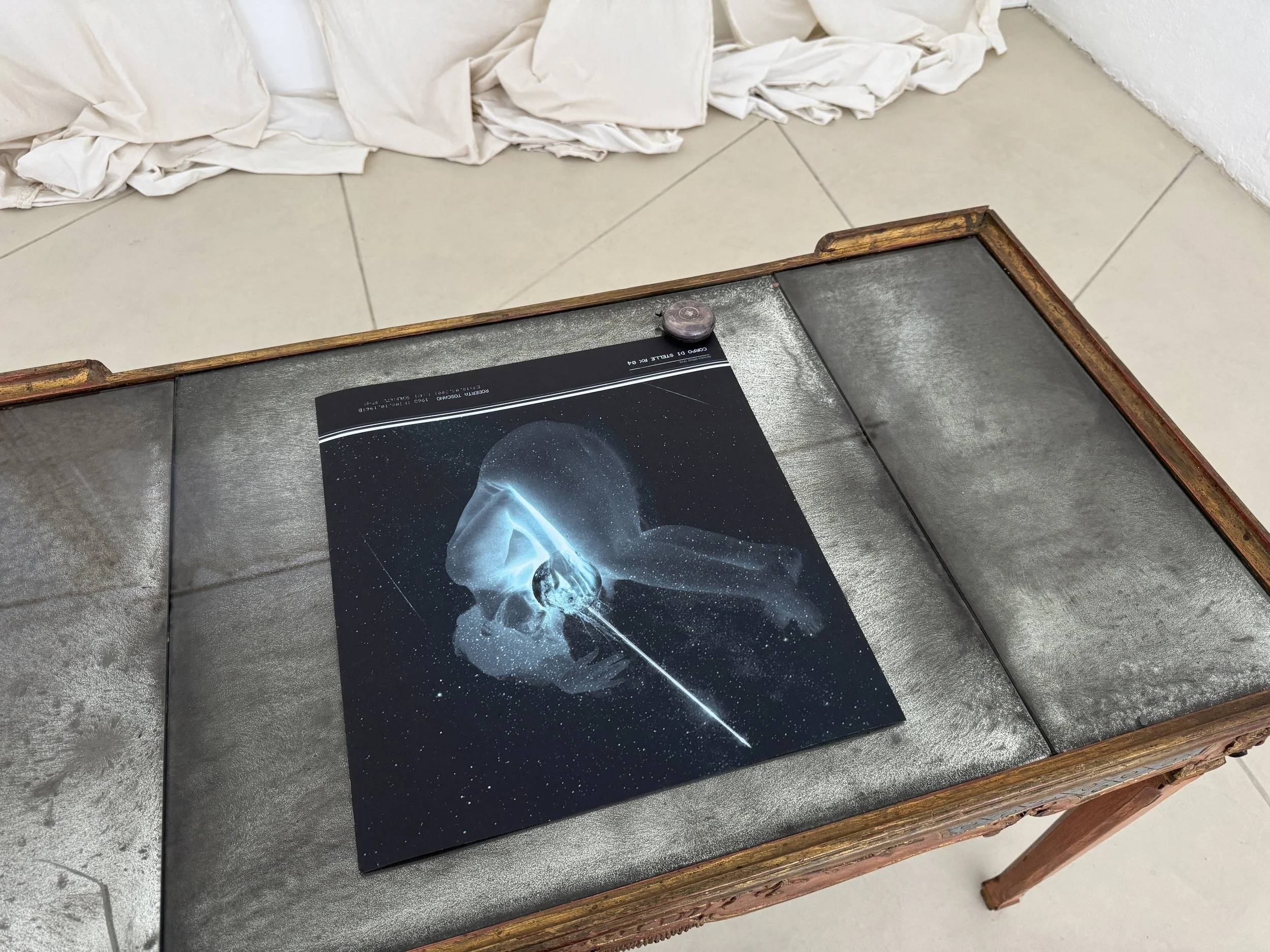
Roberta Toscano, 2025, Body of Stars RX 04 , Digital processing on blacklight film | size 16 x 14.5 inches, Edition 1/ 3
On Science and Poetics
QUESTION 7 - Science plays an important role in the work, yet it feels deeply poetic. How do you experience the relationship between art and science in your practice? Do you see them as parallel ways of knowing, or as something that naturally intertwines?
ROBERTA: I have always been a materialist, but going through illness opened my eyes to how vital science is to our existence, and how it can be perceived in a human, moving, sincere, and deeply helpful light. My mother has Alzheimer’s disease, and the fact that there is currently no cure for it is incredibly sad and frustrating. I, on the other hand, survived. I managed to recover from cancer thanks to science; it grants me the daily joy of opening my eyes every morning, and for this, I am immensely grateful. I believe art and science intertwined naturally in my work, both rooted in the shared human drive to discover and evolve. As an artist, I feel the need to use multiple languages, so I appropriated science just as I previously did with video art, experimental graphics, photography, and performance.
Lately, art has also gained significant recognition as a form of healthcare therapy. There are museum visits specifically designed to foster well-being, and scientific data proves that art can accelerate healing processes by lifting a patient's mood. Even within art history, the technological shift from analog to digital photography initially seemed traumatic and unpoetic. In reality, digital tools opened up vast new horizons and possibilities for artists who use photography, without entirely erasing the darkroom or the printing press. My own background in graphic design, while rooted in traditional techniques, was heavily shaped by experimentation, leading me to digital mediums. Now, artificial intelligence has arrived, another massive revolution waiting to be explored.
On Time and Scale
QUESTION 8 - The work seems to hold both the intimacy of the body and the vastness of the universe. How do you navigate these different scales?
ROBERTA: Consider the teeming world of insects or bacteria: we can only observe it under a microscope, yet it exists. Contemplating the sheer scale of the universe compared to us can sometimes provoke anxiety and fear, but without that intangible stardust, we humans would never have existed in the first place. As a child, I was never afraid of diving into the vastness of the sea, because I learned to swim and to rest by simply letting my body float on the surface of the water. Above me was the vast sky, below me the enormous mass of the ocean, and there I was, contemplating the blue in a state of utter stillness. In those rare moments, a perfect balance between all elements truly exists.
QUESTION 9 - There is also a sense of time—of looking into something ancient, even cosmic. Is time something you consciously think about as you make the work?
ROBERTA: Often my life, like everyone's, is hectic, packed with commitments, duties, and promises to keep; time is never enough. Yet, when I immerse myself in my work, time slows down. I enter an almost Zen-like dimension of small but necessary actions, a state of deep concentration, wholeness, and well-being that reminds me of when I practiced Tai-chi, despite the physical effort it requires. There is an intense awareness that guides me and dictates my choices. Perhaps it is precisely this feeling of "having done the right thing" that I want people to receive at the end of the process. This definitely stems from the seriousness of the rituals I performed during playtime as a child : rediscovering that childhood fulfillment of serving a single drop of water in a tiny doll's teacup, building a block tower that became a floating house, or turning a box of buttons into a chest full of precious treasures.
On Presence and Wonder
QUESTION 10 - There is a quiet sense of wonder in the installation. Is this something you hope the viewer encounters?
ROBERTA: Yes, absolutely. I would love for the small lights scattered throughout the work to feel like the ones we contemplate on starry summer nights, lying on a beach or in a meadow, waiting in eager anticipation for shooting stars. Or like the phosphorus glowing on the sea's surface, illuminating the darkness of the waves, or an oar lifting from the water to reveal a tiny miracle of luminescence.
QUESTION 11 - When someone stands in front of the work, what kind of experience do you imagine unfolding?
ROBERTA: With this specific piece, I imagine an initial curiosity triggered by the vintage objects, evoking the viewer's own past, perhaps relating to a personal medical history or an educational memory. From there, I hope they transition into a feeling of peace, almost a quiet ecstasy. It is very much like the "suspension of disbelief" in theater: setting aside one's critical mindset for a moment to simply enjoy and experience the artwork.
Closing
QUESTION 12 - Your work invites reflection on our place within something much larger. Is there a question that continues to guide you as you move forward?
ROBERTA: Yes, certainly. The question that continues to guide me is: how can I keep alive and pass on to others the light of art's beauty?