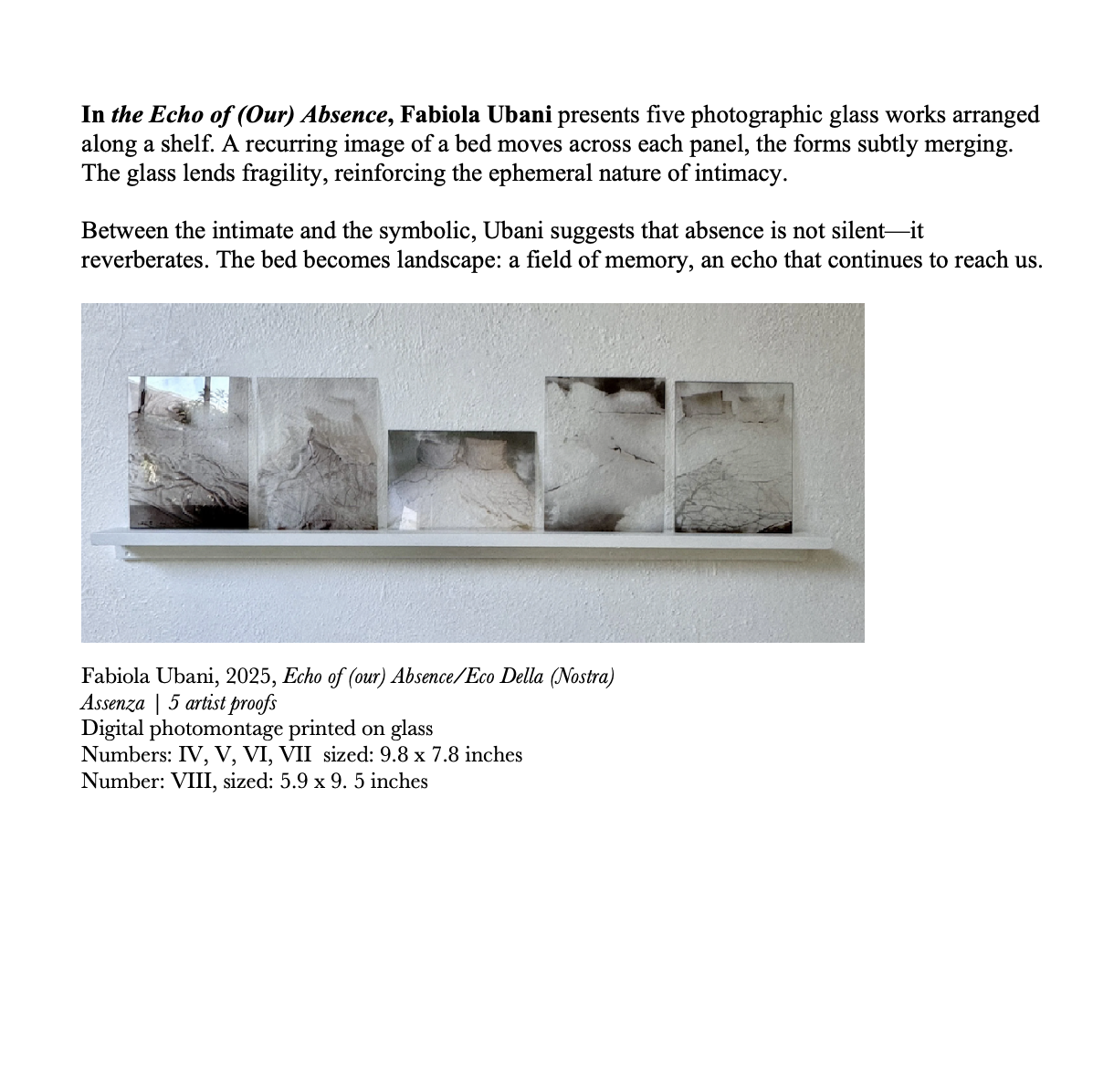
Fabiola Ubani, 2025, Echo of (our) Absence/Eco Della (Nostra) Assenza | 5 artist proofs | Digital photo-montage printed on glass
FEATURED IN PHOTOGRAPHY INTO SCULPTURE - AN HOMAGE AND AN UPDATE - EL NIDO, LOS ANGELES
INTERVIEW WITH FABIOLA UBANI
In Echo of (Our) Absence, Fabiola Ubani invites us into a space where intimacy lingers as trace rather than form—where what is no longer present continues to resonate. The work unfolds quietly: a bed becomes landscape, branches map unseen connections, and fragile materials hold the weight of memory. Moving between the personal and the symbolic, the installation asks us to reconsider absence not as loss, but as something that endures—an echo that persists within the body, the object, and the space itself.
In the following questions, we step a little closer into this field of feeling, listening to how absence might speak, and how memory takes shape through material, gesture, and image.
Question 1 - In Echo of (Our) Absence, the bed becomes more than a domestic object—what drew you to use the bed as a central image?
Fabiola: The bed, a piece of everyday furniture, interests me precisely because of its ambiguous condition: it is both object and place. A space where things happen, where intimate encounters take place, and where a relational dimension unfolds in which words lose relevance in favor of gestures, caresses, and the contact of skin.
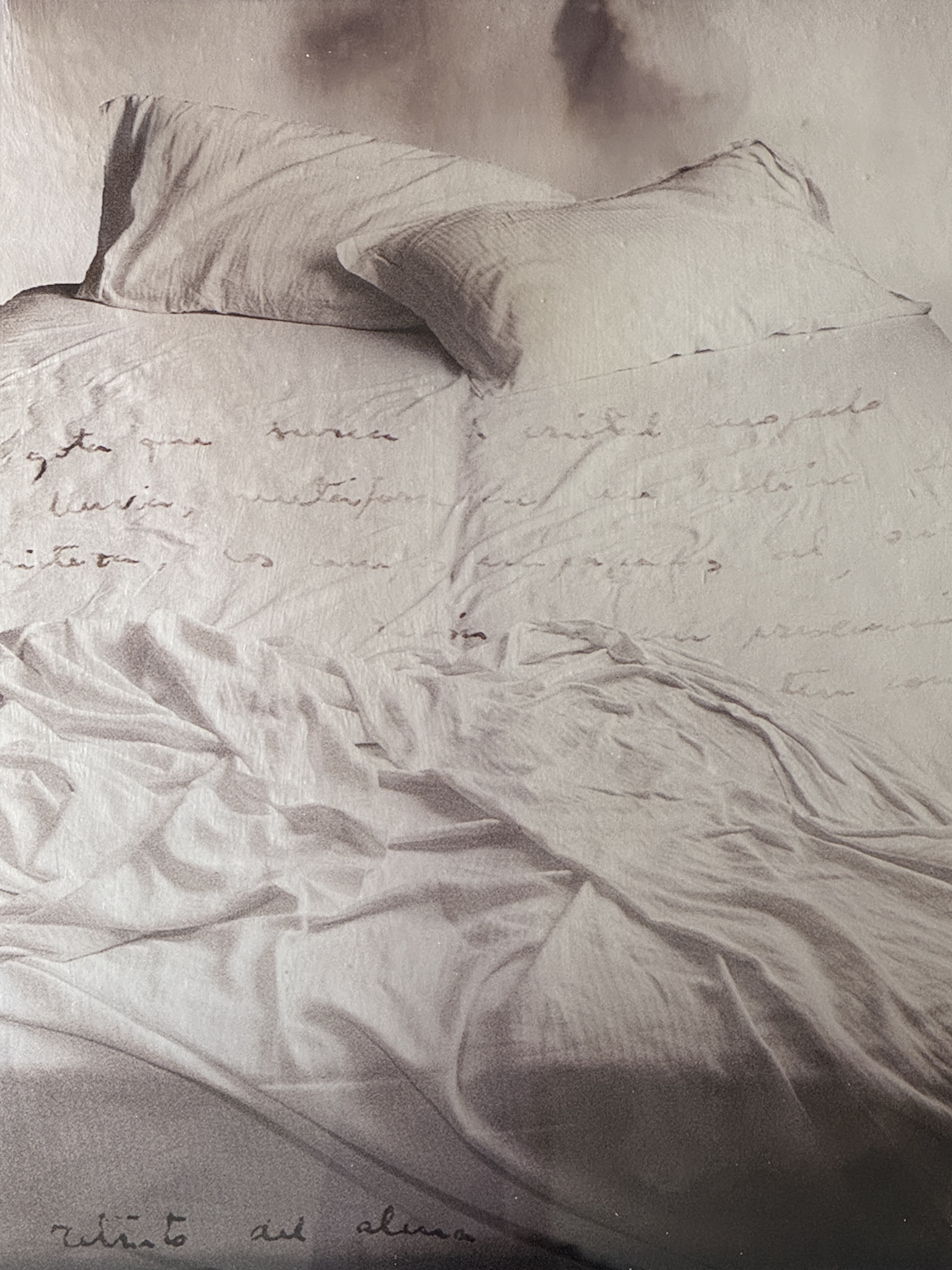
I am also drawn to its aesthetic. Disheveled sheets generate forms that evoke a kind of cartography: maps of desire, but also of forgetting. In the absence of bodies, those folds and traces become silent witnesses to what has occurred, quiet vestiges of a past experience. Paraphrasing Roland Barthes, they contain that “ça-a-été” — that-has-been — which inevitably points to memory.
For years, in my travels, I have photographed unmade beds—beds in which I have slept, loved, inhabited. For me, they constitute an intimate diary: surfaces upon which lived experience is inscribed and which condense a strong emotional and personal charge.
Question 2 - You incorporate branches that resemble roots, veins, or scars—what do these natural forms represent to you?
Fabiola: The branches form part of that cartography of desire that runs through the entire project: they are lines of encounter, trajectories that connect and tension the space. I am interested in their formal ambivalence, because they can be read as veins—conduits through which life circulates—but also as roots, or even as scars.
In this sense, they function as visual metaphors for affective experience: they speak both of intensity and connection, as well as of the wound and the memory left by contact. They are traces that inscribe a history into space, an emotional path that is not always linear, but rather fragmented, organic, and at times, vulnerable.
Question 3 - The work suggests that absence is not emptiness but a kind of presence—how do you personally understand absence?
Fabiola: I understand absence not as a void, but as a form of latent presence. Absence as trace, as residue. The beds appear empty, yet they are charged with signs: someone was there. The sheets, with their folds and marks, act as silent witnesses to the encounter; they preserve the imprint of what took place.
Photography, in this sense, functions as a device that captures and fixes that tension: it makes visible what is no longer there, yet persists as a trace. I am interested precisely in that threshold between presence and disappearance, where the image does not show the body, but invokes it. Absence thus becomes a form of memory embodied in matter, a silent evidence of lived experience.
Question 4 - Can you talk about your choice of materials, like glass, and photography, and how this relate to ideas of fragility and memory?
Fabiola: For me, technique is not a secondary aspect but a structural one: each project demands a specific material language that aligns with what I want to convey. Technique and material, in this sense, are inseparable; they construct one another and shape how the work is perceived and experienced.
In these pieces, the choice of glass as a support is not incidental. I am drawn to its fragile quality, its intrinsic vulnerability, as a metaphor for affective relationships—bonds that can fracture easily, sometimes without a clear explanation. At the same time, glass introduces the idea of transparency, of how we allow ourselves to be seen—or believe we do—in intimacy.
In a space like the bed, where verbal language loses weight, physical contact and the presence of the other generate a different form of communication, more direct, almost tactile. In this sense, glass also functions as a surface that tensions this paradox: it is transparent, yet it separates; it allows one to see, yet imposes a distance.
This apparent contradiction is not something I seek to resolve, but to inhabit. Because it is precisely within that complexity—between closeness and distance, between fragility and permanence—that memory and affective experience are inscribed.
Question 5 - The five panel glass installation creates a space between intimacy and landscape—what do you hope viewers feel or experience when they enter the work?
Fabiola: The viewer’s experience is inevitably shaped by their own biography; each person activates the work through their own lived experiences, almost like a projection surface—in that sense, it could be thought of as a Rorschach test.
Rather than directing a closed reading, I am interested in generating a space of passage between the intimate and the open, where the viewer can recognize themselves or confront their own affective memories. I aim for the work to operate on a sensorial level, to activate something more bodily than discursive: an emotion, a discomfort, a resonance.
If there is an intention, it is to touch a deep layer, even if only subtly. Not so much to impose a meaning, but to foster an experience in which each viewer completes the work from their own history.