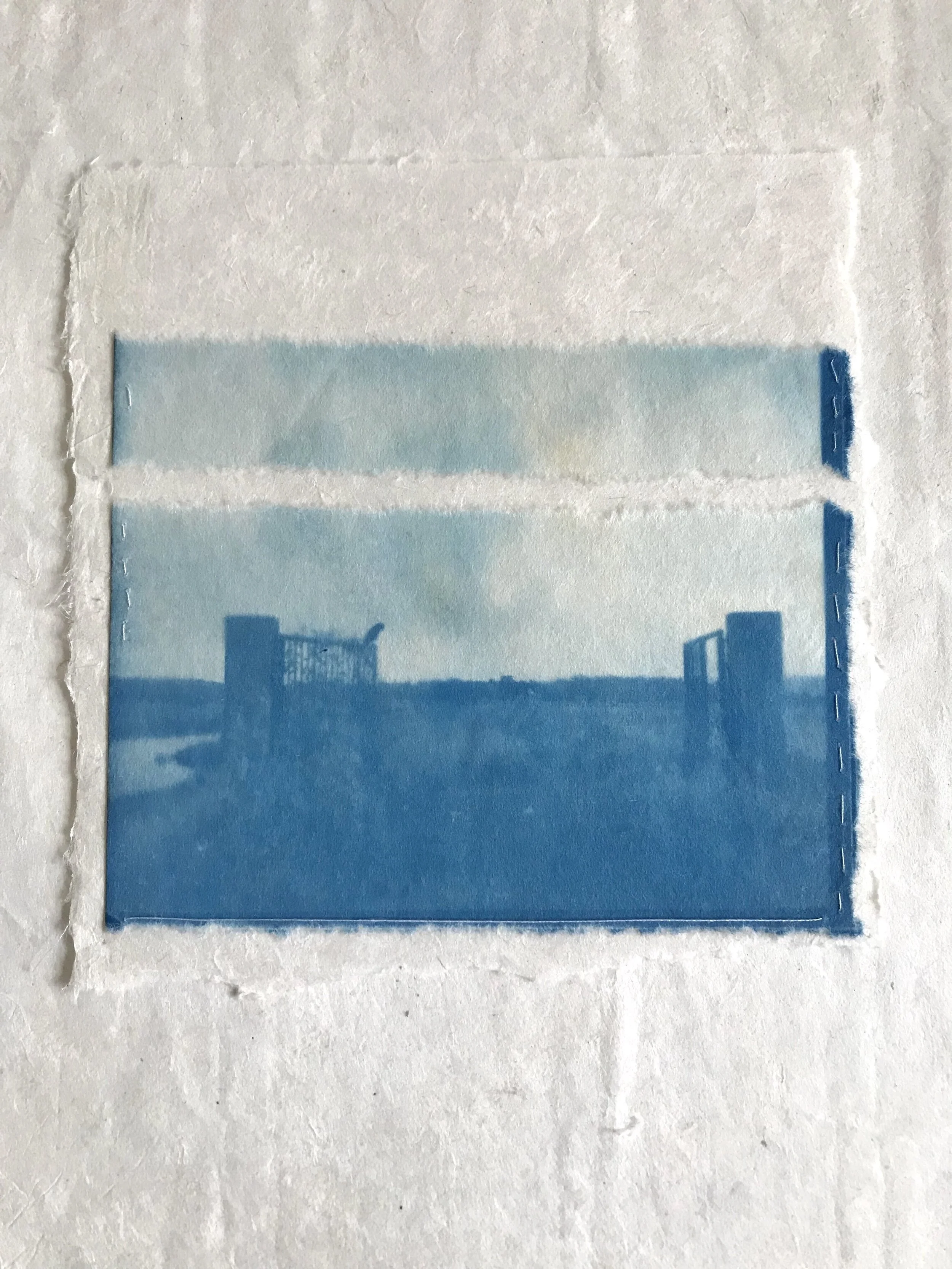
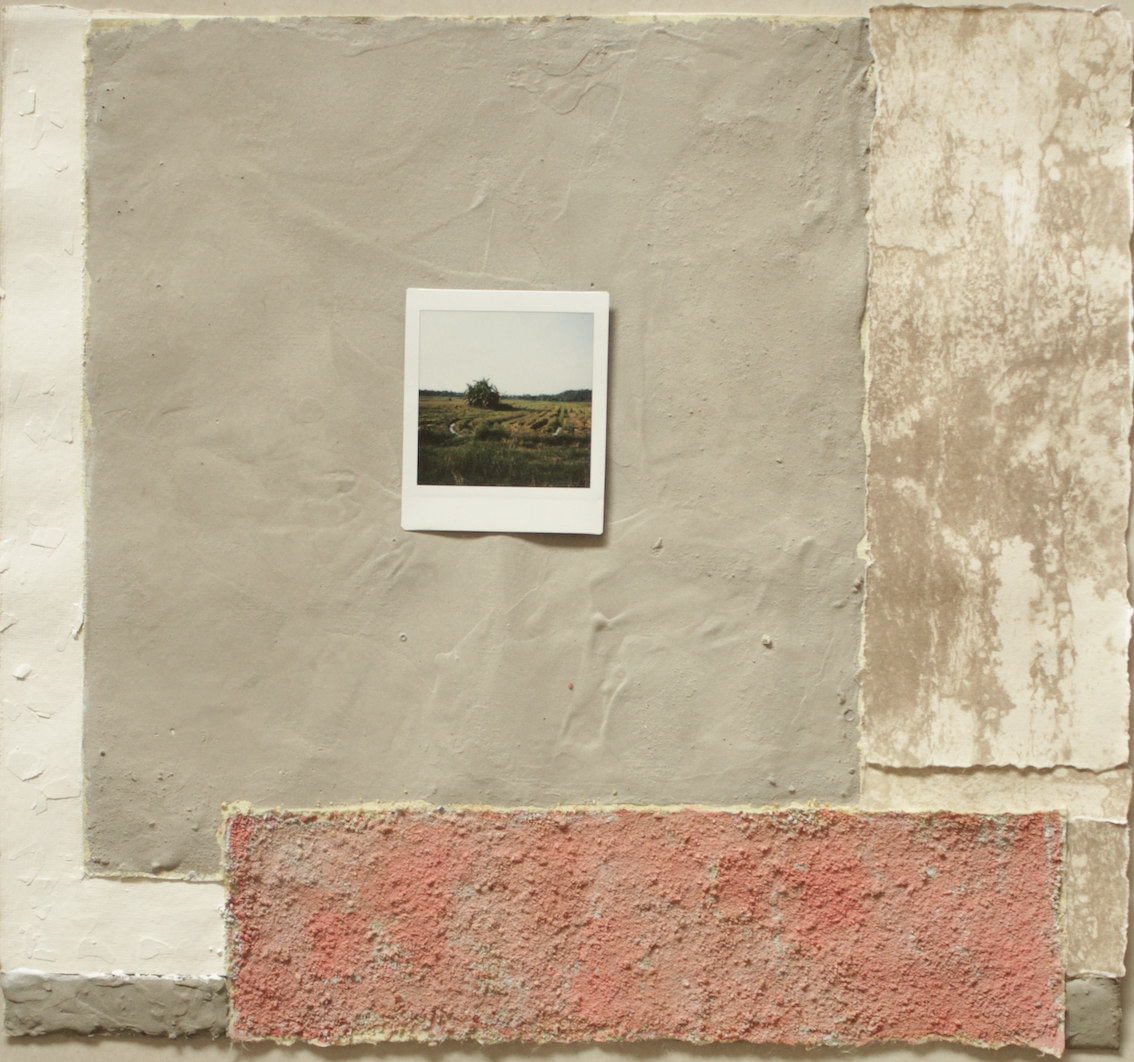
Ipshita Maitra, Silence Is The Loudest Sound - The Politics Of Space | Gaze #5, 2021, Watercolour, vandyke brown print toned with gold chloride, instax polaroid, cement, sand and powdered mica on paper
IPSHITA MAITRA: QUIET IS MY LAND
IPSHITA MAITRA
Q & A with Ipshita Maitra on Landscape
Ipshita Maitra is a lens-based artist from India who works across various forms of mixed media and collage.
VC: What does landscape mean to you—both in terms of the places you live within and the inner landscapes you carry?
IPSHITA: The space in between... this is what landscape is... what lies between the earth and the sky, between the multiple points in the galaxies, between my breath and my soul and my thoughts and complications. This immediate yet ever fluid state that is born within polarities, that calls for attention, that unravels slowly, that holds within it, multiplicity and spirals and time jumps.
This is my landscape.
Can landscape be reliable?
Is each day, just like the next, is the river the same, have the thoughts ceased.
Landscape has to be seen both as a physical entity - filled with matter - inside and outside of us/ in conjunction with - to us.
But also as a void, as a repository, a receptacle, a quiet, a zero, an absolution, white.
Both are a space of exploration. An exploration of a region born out of its contrasts...like tenderness that emerges from having borne pain. So the landscape I am witnessing, that slowly becomes a part of me, as I of it, becomes the ground to experience the entire spectrum of complex human emotions. Ours and that of others.
To communicate, to touch, to feel, to perceive, to be transformed in some way, to make record of this evolution.
Where is this landscape?
At my most romantic I like to think of it as a celestial fabric that can expand infinitely and morph continuously.
VC: How would you describe your relationship with the land where you are in India? Does it shape how you see, move, or work?
IPSHITA: The aspect of ‘Landscape’ is quite layered for me.
It is both a space to inhabit,and understand. While also being a space to question and resist and plant, while alongside being totally random and unpredictable.
Uncontrollable.
My relationship with India and to all the places I have inhabited, is actually quite intimate. The outer terrain forms a large part of my inner world. I am deeply affected by what I live around. And the neighborhood, the town, the city eventually ends up becoming a living canvas for me in the way of making work, in some way always shaping or rather communicating with my consciousness.
This happens in several phases: either in the process deliberating upon issues - social or psychic- gentrification, urban decay, environment, the function of architecture, rituals and cosmic balance; Or in the pursuit of instinctively building large photographic archives that are then further translated into tactile art works - languages of resistance to erasure and erosion, with the pictures serving as a living repository of a dissolving present;
Or separately with regards to writing and filming where this intimacy with the place, its people, its nuances... its rhythm, the things that pass between the cracks, all the unsaid stories that hang around all the time.... All of this, this landscape, shows up in the story telling and the rootedness of the work.
How we reproduce landscape speaks of our journey with it, I find this very interesting. Thus, I am constantly interpreting it. Or on finer moments, just immersing with it.
Given the relationship with both Bombay and Goa where I have lived extensively and produced work, and having experienced them in phases of transformation; themes of belonging and identity became quite central to my works. I would say landscape even assumes a philosophical dimension in my practice as it ponders upon its own passing, leaving in its wake a tender nostalgia, a weave of memory. It also shows up structurally through its subject matter and materiality which are actual records of the immediate external landscape in ‘a specific conjunction’.
There are elements of traditional processes I work with that are allusions to both time and space, referencing a particular era - a particular place - a particular practice. So I would say the impressions of landscape upon me are varied and vast - historical, imagined, sometimes born from cultural ethnicity and not necessarily restricted to my place of dwelling.
Yet no work, no thought lacks reference to a time capsule - experienced.
VC: Do the elements—earth, fire, air, and water—play a role in how you think about or approach your practice as a lens-based artist?
IPSHITA: I would definitely say the elements play a role in how I approach my work, Light - being the most tangible of them, the element of fire and sun. What we see, how much we see, what is hidden, what is burnt, how matter changes states, how the elements negate and fuel each other - these are all questions I am constantly pondering on in life generally but also while making works.
Water has an aspect of flow, passage... It carries things, holds within it memory. It also submerges, erodes, makes marks, carves, chisels.
The sun, fire carries with it permanence, illumination, vitality, a playfulness, a transmutable, purifying agent....
I think about how our associations with the elements are conditioned - ancestral and cultural.
I think about how this shapes my work with the narratives I am building. I think of the elements from the perspective of phenomenology but also just as practical agents and tools in the everydayness of being. I think of what they mean in contexts that are domestic, urban, industrial, functional. Stripped of all things ephemeral.
At a tactical and practical level with manual analogue print making the play of light and water - and their usage largely and primarily affects the outcome of prints - exposure, development, tonality, markings. This interdependence and interplay definitely make one more sensitive to the elements even from a scientific perspective like being aware of the ph levels, or temperature or
pressure in the case of water, but with this also builds an intuitive kind of connection with the same elements where approximation replaces exactitude.
VC: Are there particular elements you feel especially drawn to, or that recur in your images or films?
IPSHITA: These days I am very drawn to the breeze. At a point I was very drawn to the earth and was constantly collecting rocks and stones and crystals, and leaves and driftwood and dried flowers. But these preoccupations are circular, they shift and re emerge. I think it’s about where one is in life. In the work there is somehow a direct reflection of the internal musings. A lot of my work carries light leaks and motion blurs - wind and fire. A lot of my work is situated around water, and contains both its force as well as eerily still reflections. Sometimes I am looking at the ground a lot, sometimes the sky.
VC: How does being physically present in a place influence the way you frame, observe, or tell a story through the lens?
IPSHITA: What I perceive, receive, transmit with a space directly impacts the work that is born in it. To begin I am very sensorial and this I think directly percolates into a mood, which defines a gaze, a narrative, which in turn defines the mis en scene, lensing, tonality, aesthetics.
How time moves within a space is also a factor in what and how I record, the relationship shared with the space too, for eg. I would shoot a place, unknown and a little bit uncomfortable, entirely differently from a place which is familiar and holds warmth for me personally.
So again, the reproduction of landscape will depend on the sensory input the space confers. I can gather this information at once or over time depending on the approach of how to engage with the subject matter. Add to it, the psychological state that one is inhabiting while in the experience, and the two together more or less define the content that is produced.
Physical sensing is also multidimensional so sometimes wandering through spaces, I also follow hunches, intuit something, am caught off guard by the unexpected and sometimes the absolutely magnificent. I would say a good shot - still or moving is a synergy of all elements being in a state of absolute harmony. And this state usually, almost always arrives as a gift, not something I set out to do despite all the seeing and dreaming and planning.
So space also confers this: divine timing and intervention.
With regards to creating art, the density of a space also somehow enters the work unless one is very conscious of keeping the inner very still. This translates into more necessity driven decisions of working in solitude, in a suspension of sorts, preferably in places that also bear beauty and stillness and a close kind of proximity to nature in order to bring the same resonance into the work.
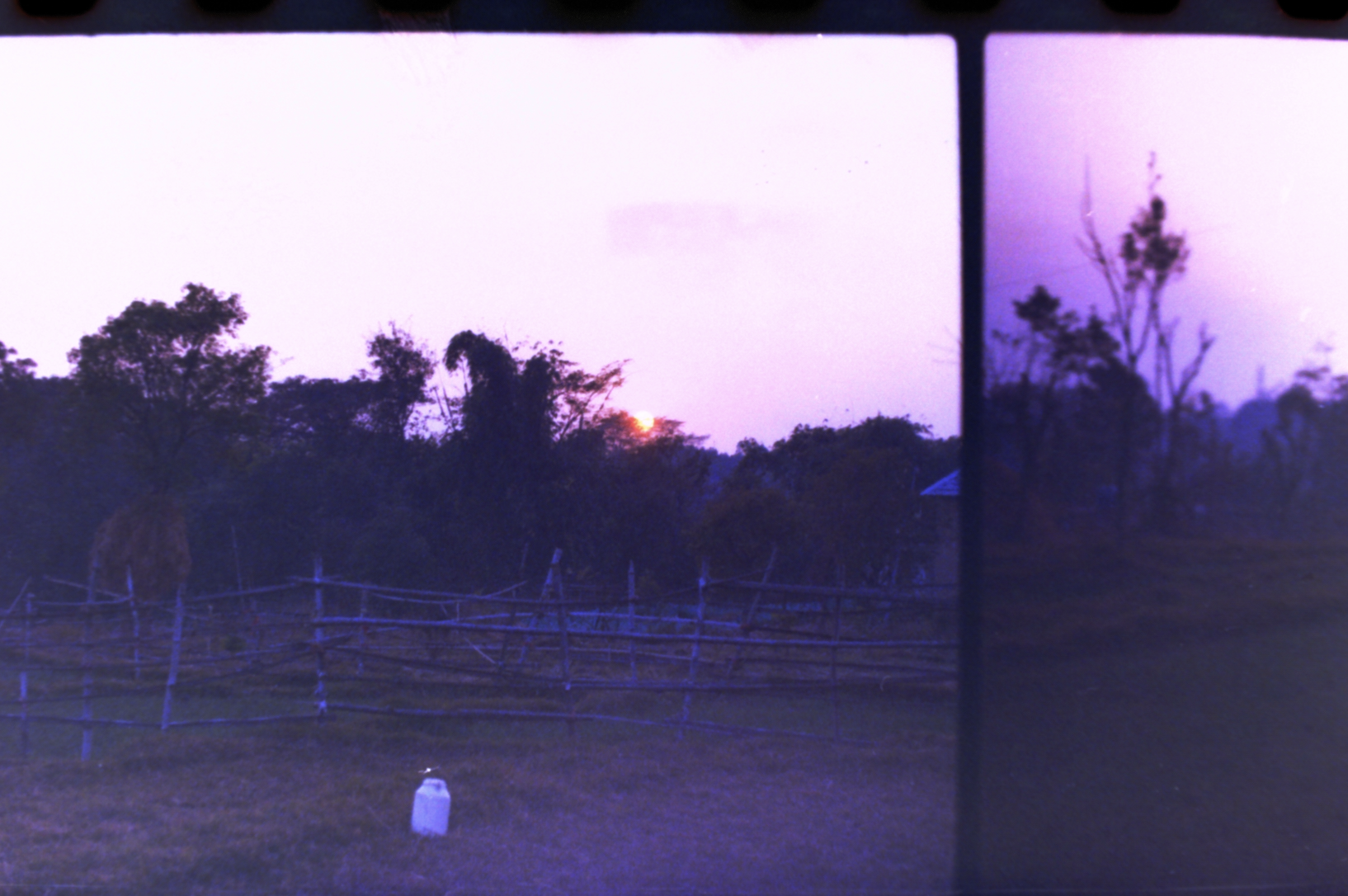
Ipshtia Maitra, Shifting Landscapes, Lucid Dreams | Untitled, 2024, Analogue photography on 35mm film, archival pigment print on Hahnemuhle cotton rag , Produced with support from Magnum Foundation
VC: Does landscape enter your filmmaking differently than it does your still-image work—and if so, how?
IPSHITA:
Time or rather the experience of it is entirely different in motion pictures vs still photography. And thus the treatment of landscape too.
Film is almost always a psychological terrain in conjunction with a social reality. So the landscape is that of the characters internal world pitted against the external terrain. Two landscapes usually at odds with each other. Sometimes the external is a reflection of the internal and even more absurd in the case of surrealist cinema. However given that cinema as a medium uses many other aspects to influence the psyche in terms of sound, colour, rhythm, montage, juxtaposition, performance- the landscape is one that is in a constant state of movement. It is ever evolving, and thus must be treated that way. A living breathing thing affected by multiple scenarios, rocketing to it own extinction.
With still photography, landscape bears a symbolic quality, a quality of suspension.
Here it is something to contemplate, something to remember, a pause of sorts, a motif, a moment of being witness, a moment of revelation. A moment of being able to peer in.
It is not so much to do, as to see, not so much to say, as to sense, to feel, because you can, because the moment is waiting. Because it exists as a repetition to revisit.
There is a ring of infinity to it. To the still photograph.
And in the making of an image, I like to think of its landscape with this in mind.