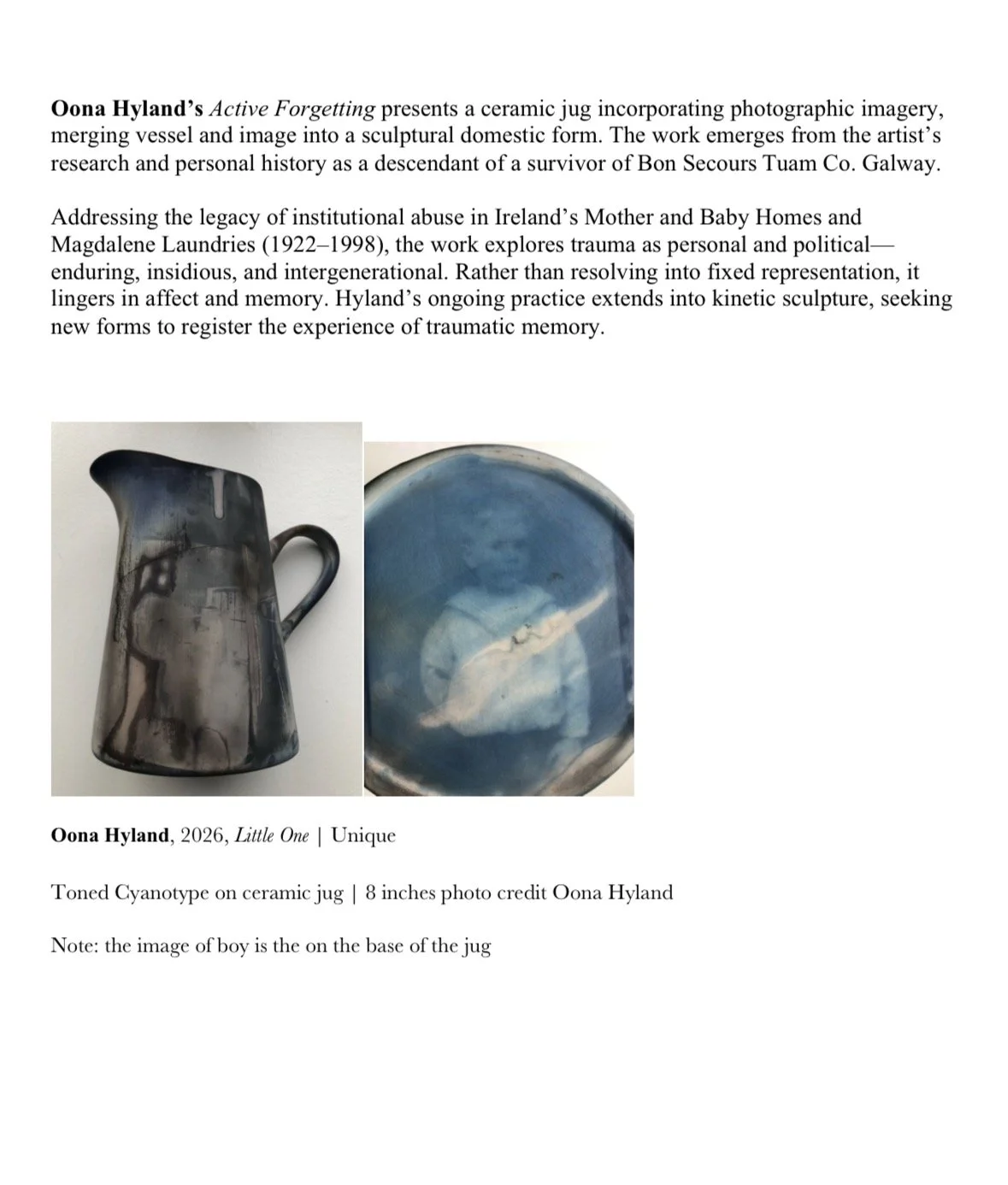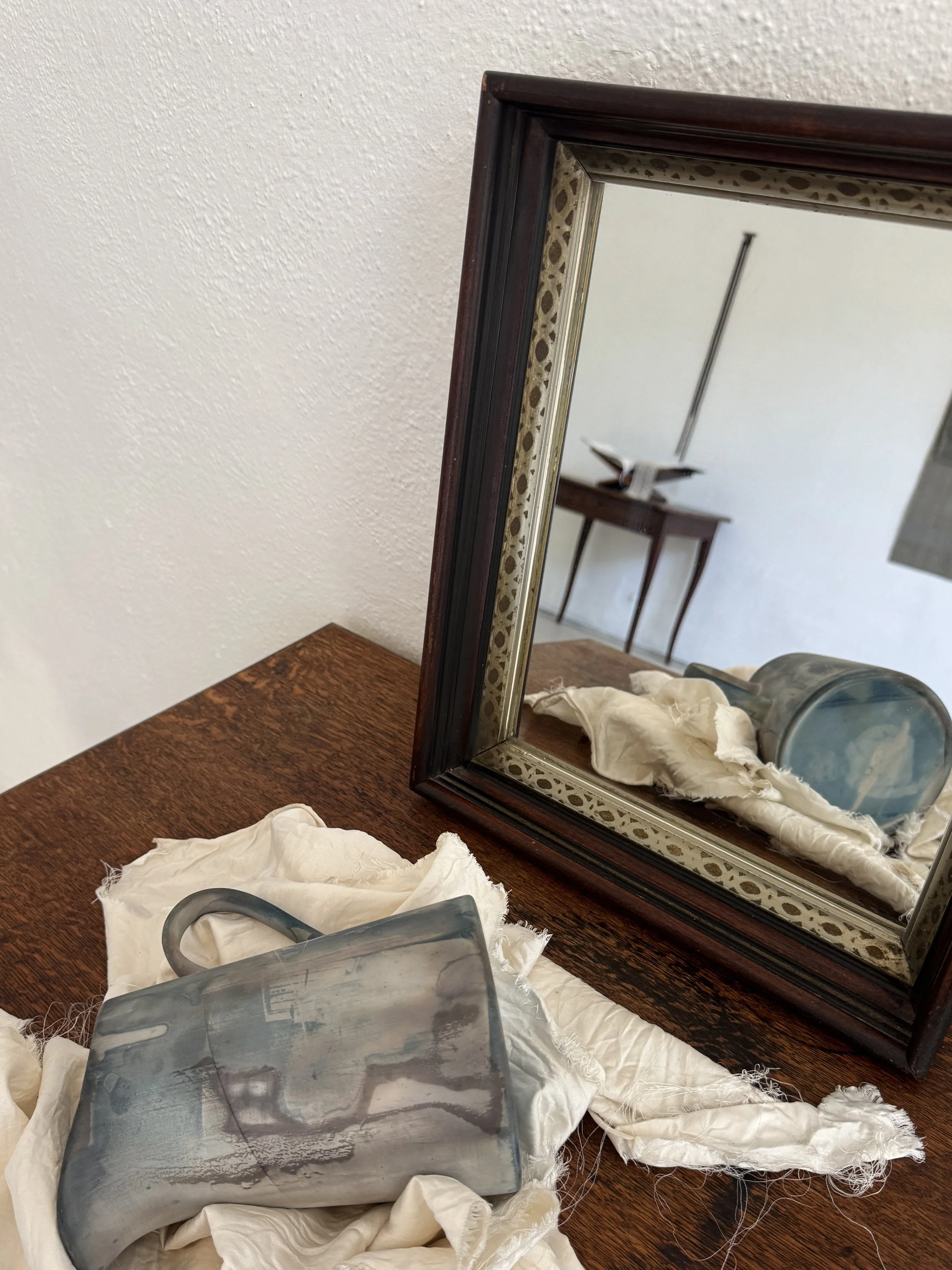
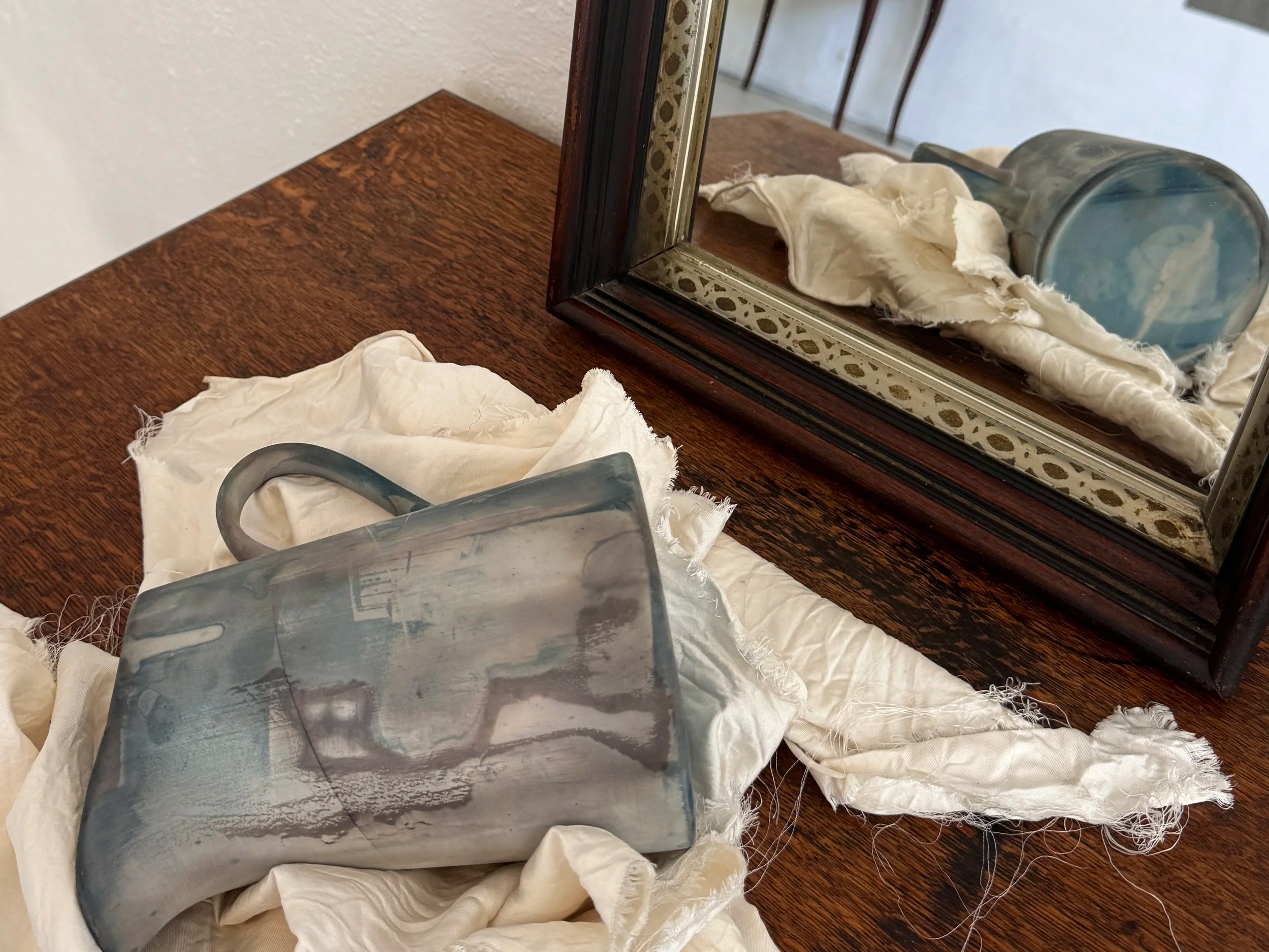
OONA HYLAND, 2026 LITTLE ONE, FROM THE ACTIVE FORGETTING SERIES, TONE CYANOTYPE ON CERAMIC JUG, 8 INCHES, UNIQUE
FEATURED IN PHOTOGRAPY INTO SCULPTURE - AN HOMAGE AND AN UPDATE - EL NIDO, LOS ANGELES
INTERVIEW WITH OONA HYLAND
ACTIVE FORGETTING
QUESTION 1. Your work Little One’s, from the series Active Forgetting, carries both a deeply personal origin and a broader historical context. How did the discovery of your family’s connection to the Bon Secours Mother and Baby Home shape the direction of this series?
OONA: The experience of discovering that my eldest brother was born in these circumstances and that the person I was closest to in my life had lived and died without sharing this with me. That she
had had this traumatic experience of giving birth as an unmarried mother in Ireland in the 1940’s. That her family (maiden aunts in London) had sent her back to Ireland because of the shame she would bring to them. This deeply shocked me. It shook my foundations. I felt huge empathy for my mother and brother. It changed my view of my parents, of their relationship and of our family. The secrecy , the silence, felt corrosive. This series began as a way of coming to terms with this.
QUESTION 2. You describe Active Forgetting as an exploration of intergenerational trauma—something ongoing, inherited, and difficult to fully articulate. How do you approach making work around something that resists representation?
OONA: With difficulty! I try to embody through my choice of materials and methods, thorough time and thought to express some aspects of this issue. It does resist representation. I try to articulate this difficulty.
QUESTION 3. The figure of the “Little One,” from a Victorian glass negative of an unknown boy, feels both specific and anonymous. What drew you to this image, and how does it function within the emotional landscape of the work?
OONA: ‘Little One’ has several connotations. This single work comes after a series of larger jugs I exhibited at Photography into Sculpture at Casa Regis but this one was made especially for this exhibition and to my mind is a distillation of those several larger pieces. The figure of the Victorian child is representative of all the ‘little ones’ lost at Tuam ( 796 bodies discovered in a sewage area adjacent to the home in 2013) My brother survived and my mother was able to reclaim him (after marrying my father) . The image of the anonymous Little One is on the base of the jug. This renders him invisible, physically and metaphorically - as in life, in death, in history and in the current legal context.
QUESTION 4. Your process—working at night, using UV light, long exposures, and hand-toning with black tea—feels quiet and durational. Does this way of working reflect how memory or experience unfolds for you over time?
OONA: Yes- it takes time throughout which you are considering this subject so intensely that you become subsumed by it. It is meditative and I feel it is healing. To suspend logical thought and experience the accidental nature of some of these processes- it’s part alchemy, part chance and seems to have a life of its own. I love that.
QUESTION 5- The jug, as a vessel, carries associations of the domestic and the body. In your work, does it hold, protect, or perhaps conceal what is attached to it?
OONA: The jug is a potent symbol, it's been in my mind since I saw the painting :The Servant girl at Emmaus by Velazquez many years ago. The jug is a potent symbol. It denotes service, it’s a domestic object and very much a female one. Of course ceramic jugs are made of clay and clay is of the land, so much conflict is land based, property based. So here is this object, a container of meaning. But my jug is empty and the images are bound to it with fragile threads in the process of making them. The threads ,as in the rest of the Active Forgetting works,
symbolise the laundry. The servitude the women experienced and continue to experience, and the fragility of human life. I’m interested in the way focus relates to these three dimensional objects- where they are bound tightly the image is clear and where they are loose the focus softens and leaves traces, all this fascinates me. In this way memory and experience are evoked.
QUESTION 6 - Finally, what does it mean for this work to exist as a singular object? How does that sense of uniqueness relate to memory, trace, and presence for you?
OONA: This is new to me, I usually work in multiples. The sense of uniqueness, of memory and trace does evoke presence in this work. It is just one jug. One world. But there is a whole galaxy of others waiting to be made, shown, considered, expressed. This is just one Little One.
MAY 6, 2026
OONA HYLAND - DUBLIN
VICTORIA CHAPMAN - LOS ANGELES