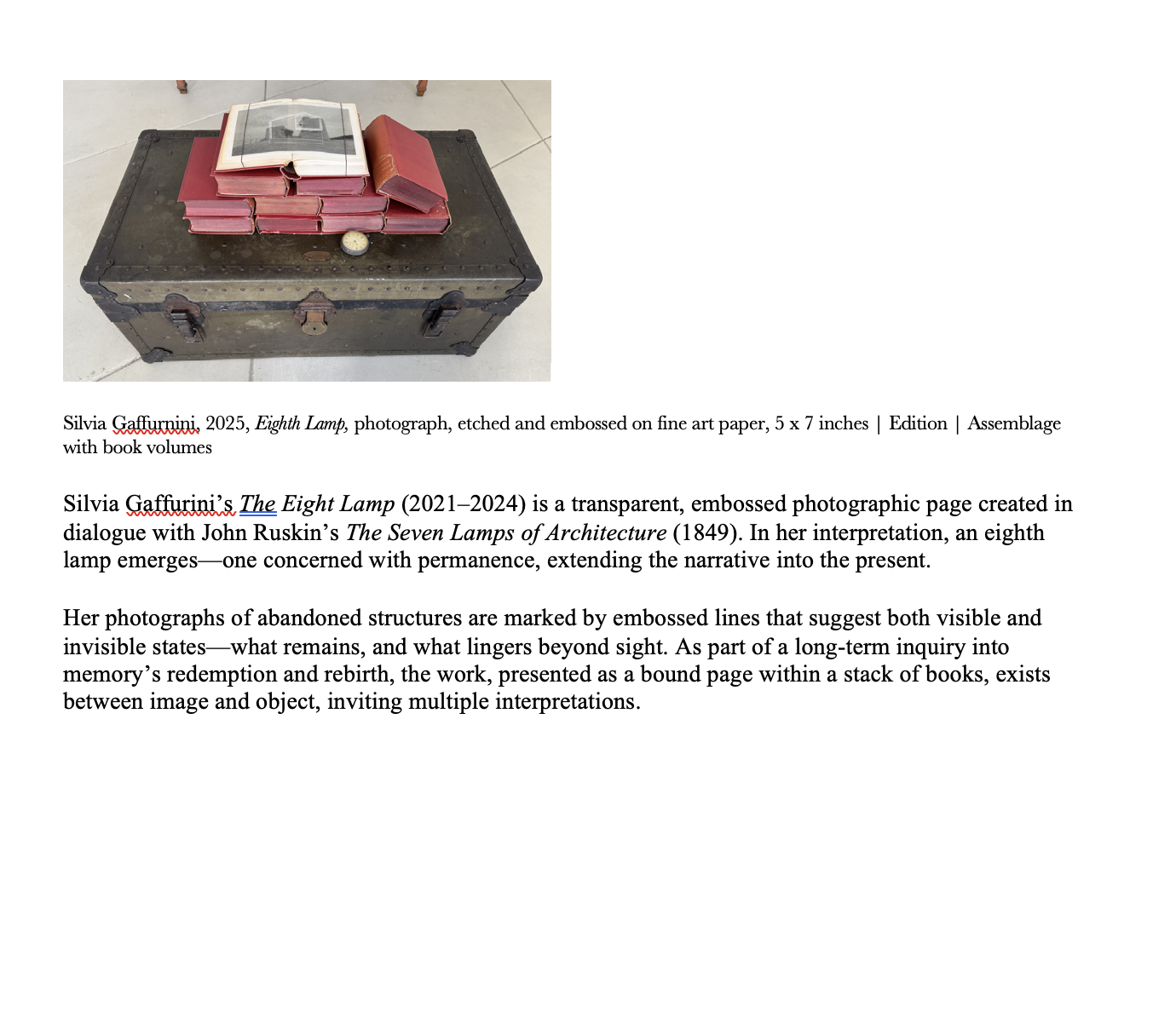
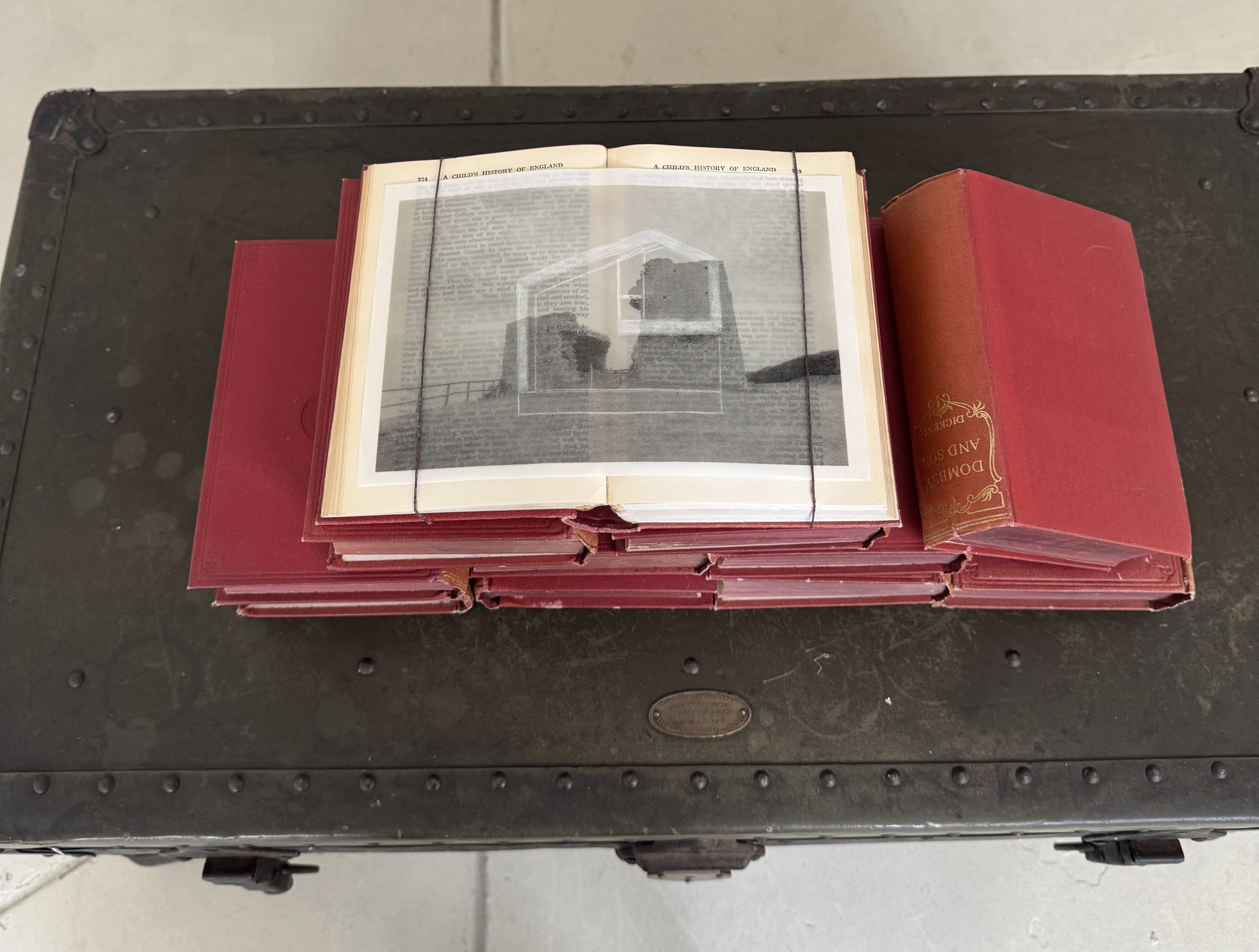
SILVIA GAFFURINI, THE EIGHTH LAMP, 2025 Photograph, etched and embossed on fine art paper, 5 x 7 inches | Edition, Assemblage with book volumes
FEATURED IN PHOTOGRAPY INTO SCULPTURE - AN HOMAGE AND AN UPDATE - EL NIDO, LOS ANGELES
INTERVIEW WITH SILVIA GAFFURINI
THE EIGHTH LAMP
Question 1: The project ‘The Eighth Lamp’ began in 2022, it is one of my favorite bodies of work you have created. The intention drawn from John Ruskin’s text ‘The Seven Lamps of Architecture’ is to depict architecture, in the case of your work you chose remaining ruins, as allegories. How did you arrive at this?
Silvia: I often spend my summer holidays in the small village of Petacciato, in the Molise region. There, I encountered these utilitarian architectures, devoid of aesthetic intention: a Saracen watchtower, a rural chapel, a shelter for livestock. Functional structures born out of the needs of communities that lived between the hills and the Adriatic Sea. These constructions, rich in rural memory, have now become ruins in a state of abandonment, scattered throughout the landscape.
This condition of neglect, together with their decaying beauty, sparked in me the desire to restore their dignity through photography, giving rise to the project “The Eighth Lamp”, inspired by John Ruskin’s text The Seven Lamps of Architecture.
Question 2: What do these ruins and allegories mean to you and what are your wishes for the viewer?
Silvia: Their meaning lies in their tenacious “permanence,” rooted in the ground as a metaphor for longevity, strength, and resilience—qualities that are also reflected in the use of stone and lime. In this way, the materials acquire a semantic value, expressing the knowledge of local building techniques and embodying the tenacity of the communities that once lived in this place.
Question 3: This series is delicately embossed or scored and the paper is transparent, what brought you to work with the photographic medium in this manner?
Silvia:Through a visual research practice that combines photographic documentation and artistic intervention, I have introduced a new three-dimensional dimension into photography, establishing a relationship between what is destined to disappear and what can be regenerated. In this way, these reworked ruins—both materially and conceptually, through manual embossing—emerge as symbols of a possible reinterpretation of the values of the past, capable of generating new vitality and opening up future perspectives.
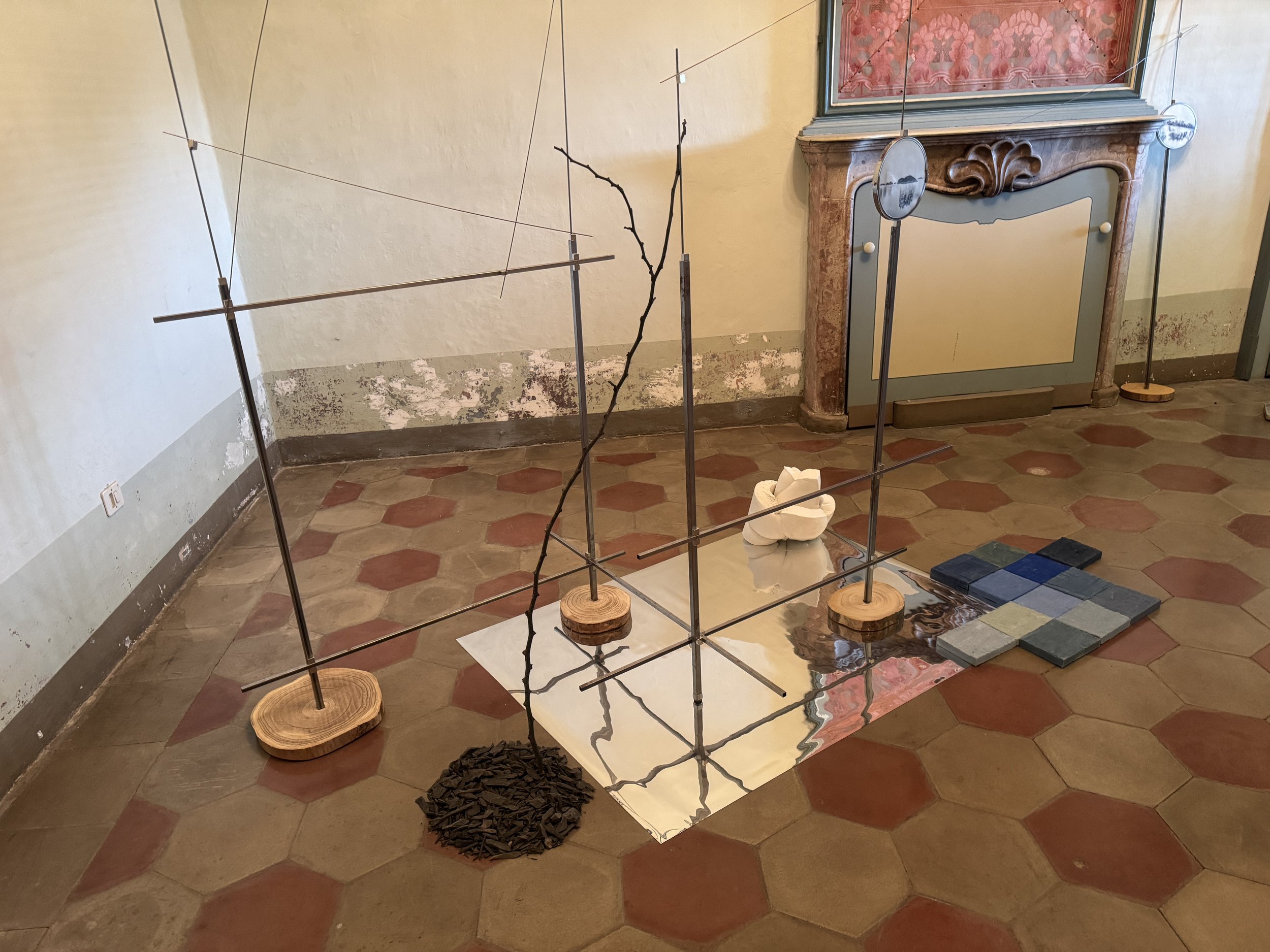
Question 4: The title of the exhibition, Photography Into Sculpture: an homage and an update, is centered around photography and its potential of being viewed beyond a 2-dimension state away from traditional methods of viewing. Your work in the exhibition, Sponge Cities, the large sculptural piece with the metal rods, magnets, photographs, sponges, rocks, plant life and more, has cleared moved into sculpture over a framed work. Was this a natural evolution for your work? How do you feel about photography as sculpture in this age?
Silvia:Yes, it was a natural evolution. With embossed photography, I had already moved beyond the limits of two-dimensionality; with “Sponge City,” in the environmental installation presented in the exhibition “Photography Into Sculpture: an homage and an update” at Casa Regis, I sought to further expand my practice and experiment—above all in response to a creative necessity tied to the narrative of this project, which pays homage to the landscape of Chinese sponge cities, defined as “terrestrial cells of life.”These urban amphibious environments, explored following my artist residency in China, reawakened my desire to address themes of interspecies coexistence within the urban landscape, which has now become the central focus of my current artistic research.
By hybridizing photography with sculpture and installation, I believe its mode of reception can also express and strengthen the message.
APRIL 22, 2026
SILVIA GAFFURINI - PIEDMONTE REGION
VICTORIA CHAPMAN - LOS ANGELES