Photography Into Sculpture — an homage and an update
(notes on object and image)
This text forms part of an ongoing research inquiry into the transformation of photographic images into objects, and the conditions under which they are encountered.
ARTIST OBJECTS SHOWN HERE AS A GROUPING : OONA HYLAND, BENNIE FLORES ANSELL, ROBERTA TOSCANO, DAWN SURRATT AND SILVIA GAFFURINI
Photography Into Sculpture — an homage and an update
A Collection of Objects Which Have No Function but to Be Adored
Works by: L. Mikelle Standbridge, Bennie Flores Ansell, Roberta Toscano, Fabiola Ubani, Oona Hyland, Dawn Surratt, Silvia Gaffurini, and Olga Caldas
Curated by L. Mikelle Standbridge
Staged by Victoria Chapman, El Nido
I brought this exhibition back with me from Italy, carrying with it not only the works, but a certain way of looking. In re-situating it at El Nido, the scale changed, the light changed, and with that, the experience of the objects shifted.
What remained was the encounter.
Objects do not fully disclose themselves at once. What we see is never neutral; we bring to them our own histories, our own sensitivities, our own ways of looking. Meaning does not reside solely within the object but emerges through the act of perception.
I found myself thinking of Musaeum Clausum—a sealed museum, also known as a secret library—described by Sir Thomas Browne as a collection of rarities, pictures, antiquities, and objects that no man has seen.
Browne’s catalogue does not seek to gather what exists, but to mark the limits of what can be known, possessed, or fully apprehended. It is a museum not of objects, but of absence—of things that resist being held, even in description. In this way, it reflects a deeper condition: that what we seek to preserve, to name, or to understand, ultimately exceeds us.
Here, the condition is reversed. The objects before us are entirely present. They can be approached, circled, and observed. They occupy space with us.
And yet, something does not fully settle.
The works gathered here do not resolve into use, nor do they submit to fixed meaning. They resist function. They remain instead as objects to be viewed—held in attention, and, perhaps, adored.
At El Nido, they are not arranged to explain themselves. They are placed with space around them, allowing each object to hold its own rhythm. A glass panel, a book, a suspended strand, an image resting on a surface—each becomes something to sit with, rather than move past.
A Catalogue of Objects—Present, Yet Not Entirely Accounted For
Not a catalogue of the unseen, but of what is present—and yet does not fully resolve.
A handmade book, bound as if to preserve something already in the process of vanishing.
In the work of Olga Caldas, figures appear inscribed with names across the skin—as though identity itself were both record and erasure. The book becomes both container and trace, holding something that cannot be fully kept.
A suspended scroll, unfolding in space.
In Photo-Scrolling, by L. Mikelle Standbridge, images emerge and recede across fine art paper, revealed in layers. The work extends beyond itself—QR codes trace outward into histories of an Italian missionary, mathematician, and astronomer at the Chinese Court. Constellations appear through imagery derived from tools once used to make tea—the domestic opening into the cosmic. Ownership, authorship, and origin remain in motion.
A strand composed of perforated film, threaded into a new timeline.
In Film Sprocket Timelines (2016–2017), fragments from different decades collapse into one another. What was once a series of discrete frames becomes continuous—shell-like forms, strung together, suspended. Photography, often understood as a singular captured instant, is extended here into duration: a chain of memory rather than a fixed image.
An image embossed with markings of uncertain origin.
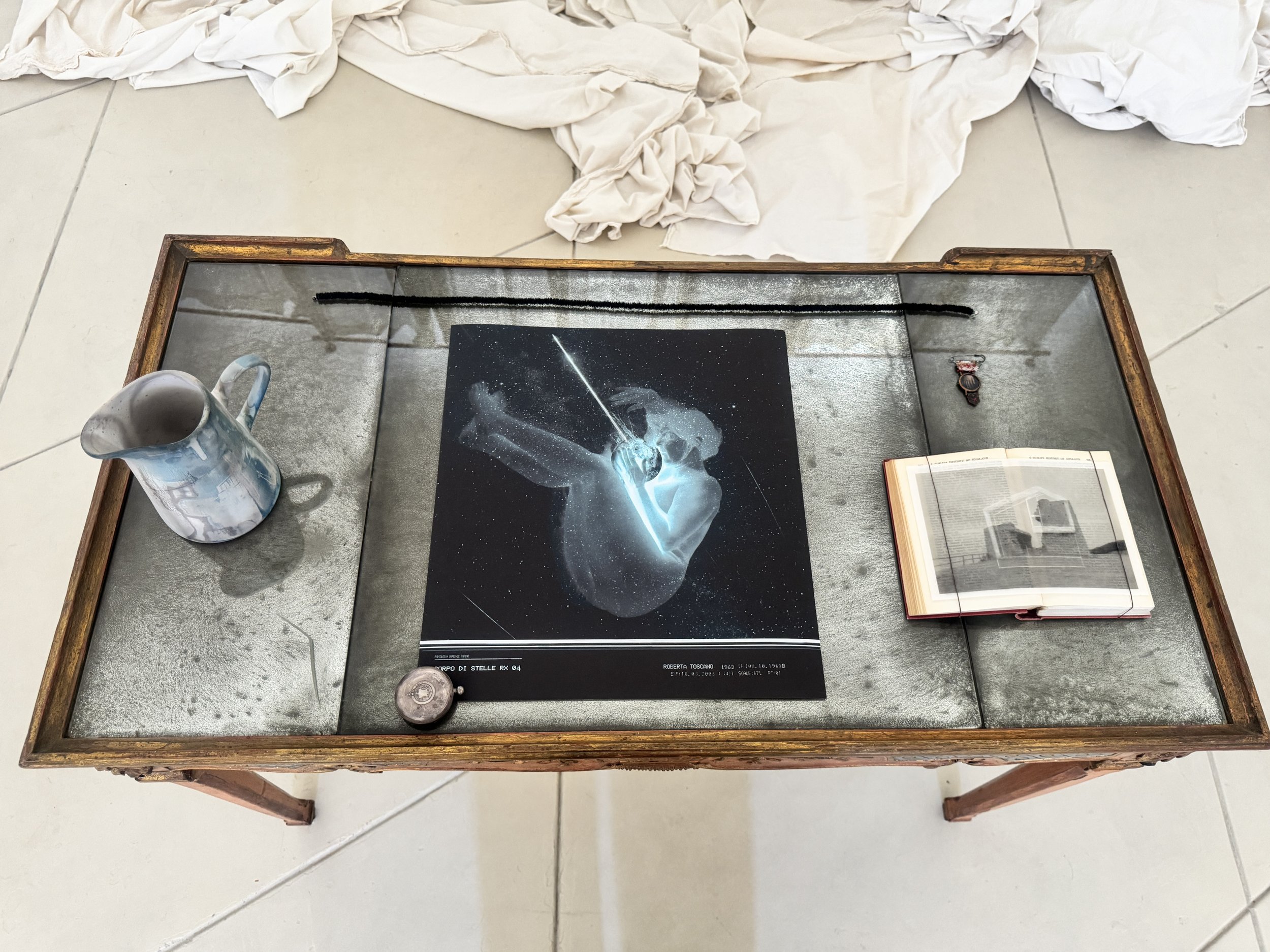
In Eighth Lamp, Silvia Gaffurini presents a ruin that suggests a system not yet known—a mapping of potential rather than place. The image rests upon a bound volume, stacked with fourteen red leather books by Charles Dickens, opened to A Child’s History of England. It hovers between archive and apparition, asking where these marks come from, and where they might lead.
A body rendered as constellation.
In Corpo di stelle, Roberta Toscano dissolves the human form into a field of stars—the interior made exterior, the body rendered atmospheric. Celestial imagery—moon, earth, distant stars—interweaves with the figure, forming a dialogue between the microcosm of the body and the macrocosm of the universe. Where does the body end, and where does the cosmos begin?
A bed, unmade—no longer a bed, but a field of memory.
In Echo of Our Presence, Fabiola Ubani transforms the domestic into a cartography of emotion. Across translucent glass panels, images shift and layer: ghostly exposures, fragments of writing, traces of branches. The bed becomes landscape—lines extending like roots, veins, or scars. Absence is not emptiness here, but another form of presence—felt, cerebral, and quietly insistent.
An object once made for use, now held in suspension.
A brush constructed from nails, overlaid with the image of a woman in delicate undergarments. In the work of L. Mikelle Standbridge, the object is reconfigured—no longer for use but held between function and adornment.
A jug bearing, at its base, the faint presence of an anonymous Victorian boy, produced through cyanotype, with its photographic elements fixed in black tea. In the work of Oona Hyland, narratives appear partial, coded, and unresolved suggesting something remembered, yet never fully disclosed.
A box reconfigured; its contents reassembled as memory.
In Dawn Surratt’s transformation of a vintage cutlery case, objects once ordinary become intimate relics real and in photographic form: buttons, thread, paper, a moth, a fragment of writing. Nearby, a timepiece reconstructed from paper, cloth, leather, and thread no longer measures time, but holds it—or releases it. These are not instruments, but quiet reliquaries of the intimate and the discarded.
All of these objects, though materially present, do not submit to fixed meaning. They remain suspended—between document and invention, relic and proposition—requiring not use, but attention.
Over time, the works begin to shift. Not physically, but perceptually. What first appears as image becomes imprint, trace, question.
The X-ray body opens into the cosmos.
The bed becomes a landscape of memory.
The book holds something already slipping away.
The smallest object begins to feel expansive.
In this way, the exhibition approaches the proposition set forth in Musaeum Clausum—not by presenting what cannot be seen, but by revealing that even what is seen does not fully resolve.
If Sir Thomas Browne imagined a sealed museum—a catalogue of the unseen—this becomes something else: a gathering of what is present, yet not entirely accounted for.
Within the intimate space of El Nido, the objects are held in suspension. They do not ask to be used, nor do they settle into fixed meaning. They remain, instead, within an interval—brief, perceptual, and shared.
And what the viewer encounters is not a conclusion, but a condition:
to look,
to remain,
and to hold what resists completion.
— Victoria Chapman
El Nido, Los Angeles
April 20, 2026
ongoing..
photo credit: vc projects